
Leucadendron salignum x laureolum ‘Maui Sunset’
cone bush
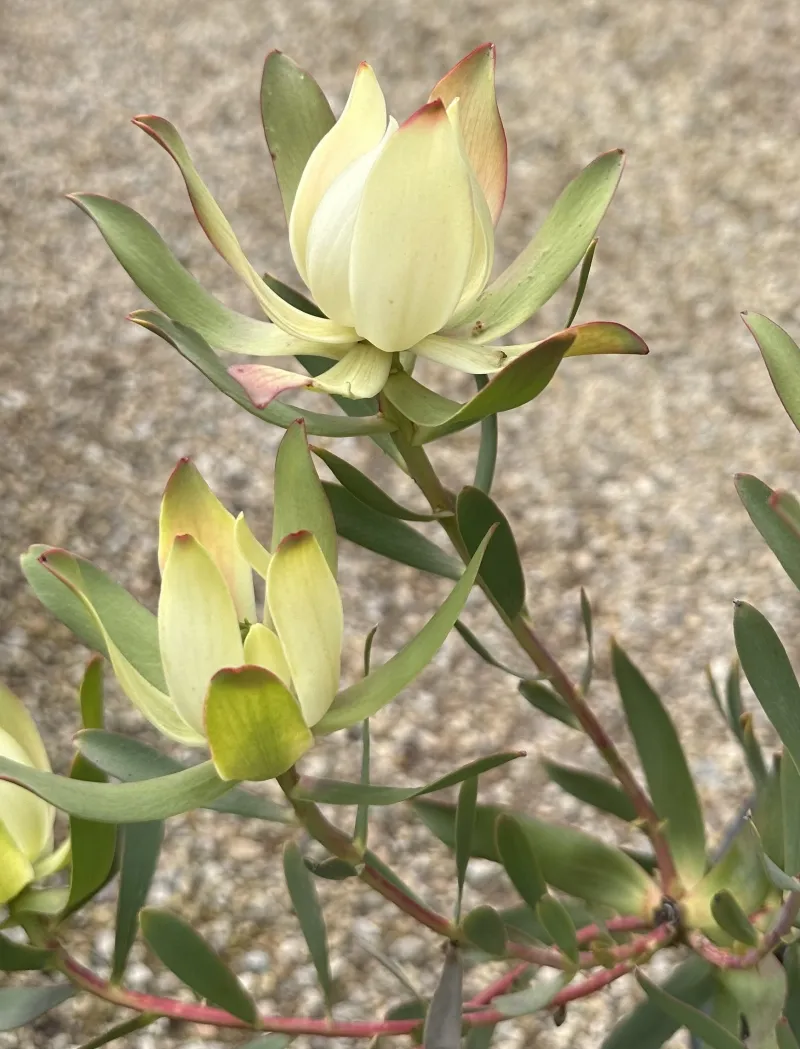
Tidy blue-green shrub with burgundy winter growth. Spring brings strikingly beautiful creamy bracts at the branch tips. These hue pink as summer approaches.
 Sinónimos Sinónimos | Leucadendron 'Maui Sunrise' |
|---|---|
 Altura Altura | 4–6 pies |
 Ancho Ancho | 4–5 pies |
 Tolera Tolera | Costa, Macetas, Viento |
 Riego Riego | Bajo – Moderado |
Leucadendrons are from Mediterranean areas of South Africa, so they're right at home in coastal California. Once established they are quite drought tolerant, but they will grow and look their best with deep watering every two or three weeks during summer. These plants prefer well-drained soil, but most leucadendrons are fairly adaptable. If you have heavier soil be careful not to oversaturate your plant, and water very infrequently during summer, once established. | |
 Resiste hasta Resiste hasta | 25 °F |
 Exposición Exposición | Sombra parcial – Pleno sol |
 Características Características | Arbusto |
 Interior / exterior Interior / exterior | Exterior |
 Drenaje Drenaje | En el suelo: mezcla para cactus, En maceta: mezcla para cactus, Tolera suelo arenoso |
 Fertilización Fertilización | Harina de sangre, Emulsión de pescado, Necesita poco, Sin fósforo |
 Origen Origen | Híbrido, Sudáfrica |
 Nativa de California Nativa de California | No |
 Zonas Sunset Zonas Sunset | 16, 17, 20–24, H2 |
Notas de cultivo
Leucadendrons, even bushy ones, have a clean upright form. They can be pruned to either be bushier, by trimming back the crown after cones fade, or more upright, by pruning on the sides. It is best not to prune on growth that is more than two years old (where the branches become woody and leafless), or you risk your leucadendron not bushing back from that area. Prune up lower branches to make a tree-like form or hedge them to make a dense privacy screen.
All purpose fertilizer will kill this plant! Fertilizer is generally not necessary, though Leucadendrons prefer slightly acidic soil. Treat with cottonseed meal, iron, or other mild (low in phosphorus and potassium) acidifying fertilizer if you have basic soil. They also respond well to nitrogen, either in the form of fish emulsion or blood meal. Never give your leucadendron phosphorus, which will poison the plant and avoid potassium.
Interés especial
This Hawaiian hybrid was brought to horticulture during the 1980s and many consider it the most beautiful of all Leucadendrons. We won't pick sides, but sure can see why one would think so!
Leucadendrons don't have typical flowers, but instead they have brightly colored cones held at the branch tips, above equally bright bracts (colorful leaves below the cone). The bracts on this particular hybrid are so large and dramatic that the small cones are barely visible inside. Leucadendrons are plants are dioecious, meaning that some plants are male and others female, and the cones vary slightly by sex.
The colorful bracts of this plant make long lasting fillers for flower arrangements.
Esta información refleja las observaciones de Grubb and Nadler y de nuestra comunidad de amantes de las plantas. Siempre tomamos en cuenta las aportaciones de otros horticultores y agradecemos los comentarios de quienes tengan más información sobre el cultivo de esta planta.
© 2020–2026 Grubb and Nadler. Todos los derechos reservados.