
Agave potatorum ‘Variegata’
butterfly agave
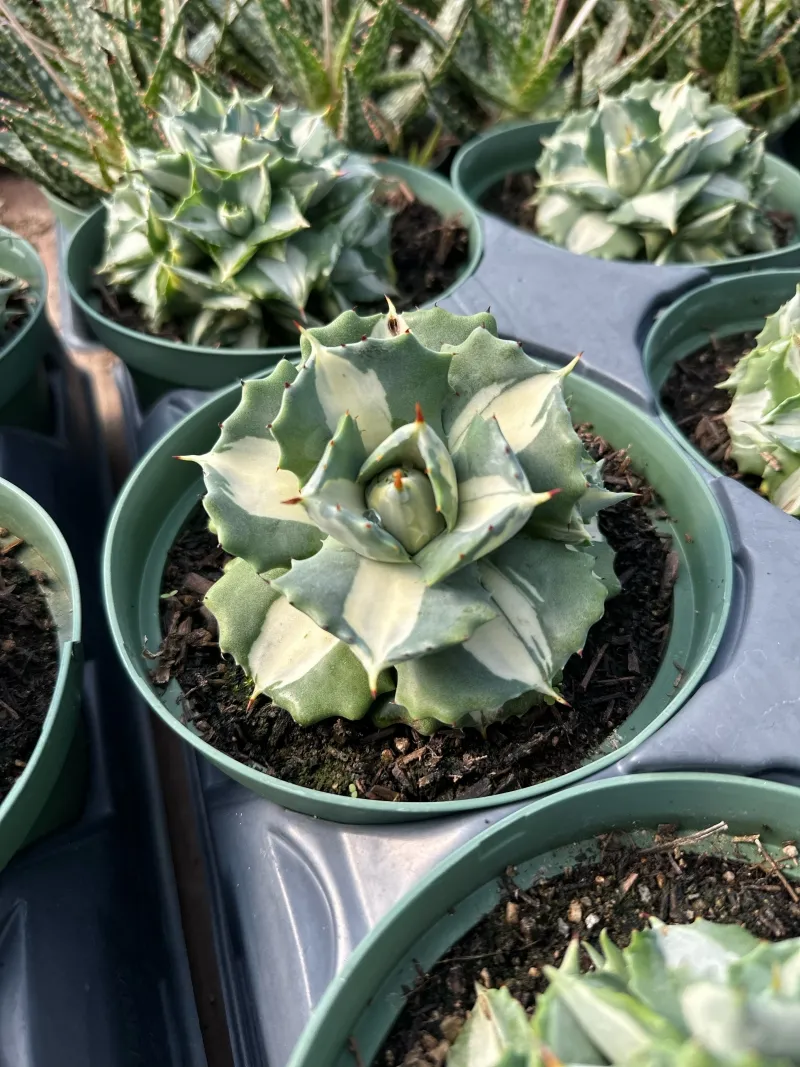
Red teeth contrast against cream margins on blue-grey leaves that flare toward the tip. Mesmerizing geometry with time.
 Height | 8–18in |
|---|---|
 Width | 12–20in |
 Tolerates | Drought, Heat, Pots, Rooftops, Neglect, Wind |
 Water needs | Low |
Agave plants are extremely drought tolerant, and many including this one need no supplemental irrigation in coastal California. They will, however, look better and grow faster if they are given additional water, especially during summer. | |
 Hardy to | 26°F |
 Exposure | Part Sun – Full Sun |
 Plant traits | Armed, Monocarpic, Sculptural, Solitary |
 Indoor / outdoor | Outdoor |
 Fertilizing | All Purpose 1/2 Strength, Low Needs |
 Origin | C Mexico |
 California native | No |
 Sunset zones | 13, 15–24, H2 |
Growing Notes
Most agave, including this one, are monocarpic, meaning that a head will grow larger and larger over time, building up energy, then send off a spectacular flower, after which they decline and die.
Take care when pruning or removing agaves, as many have a toxic sap that causes inflammation and rashing. Removing spent agave heads can also be tricky as they are often ringed with other armed agaves. If you like the look of agaves, but are threatened by the terminal spikes, they can be removed. It's easiest to cut these off when they are coming out of the rosette as you'll be able to prune the thorns off many layers of leaves at one time.
You can 'pineapple' your agave by removing the lowest leaves. This is best started while it is out of the nursery can, but before planting, when you can access leaves from the bottom. This gives the plant a short trunk, textured similar to many palms, and allows you to get under the plant for weeding.
Agaves are a great choice to grow in a pot and this is one of the best, being naturally on the smaller side.
Special Interest
Agave are excellent 'home defense' tools when planted along a fence line or beneath windows.
The above information reflects the observations of Grubb and Nadler and our extended plant community. We always consider input from fellow horticulturists and welcome feedback from those with additional information on the culture of this plant.
© 2020–2026 Grubb and Nadler. All rights reserved.