
Cotyledon orbiculata
pig's ear
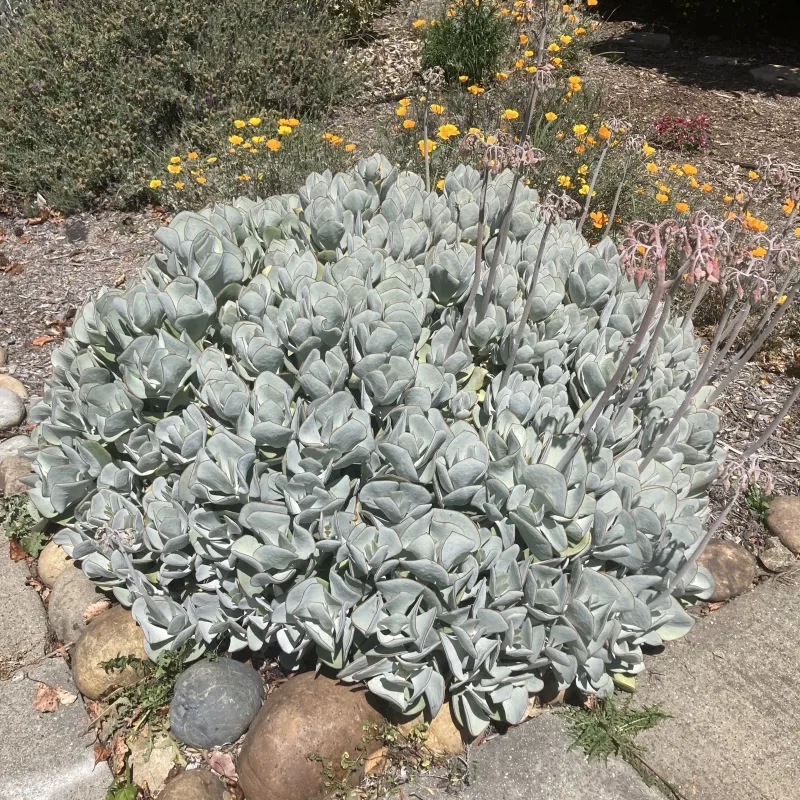
Hardy succulent with a branching, shrubby habit. Versatile and easy to grow. Nice bell-like apricot flowers on elevated stalks.
 Altura Altura | 8–18 pulg. |
|---|---|
 Ancho Ancho | 1–2 pies |
 Tolera Tolera | Costa, Veranos frescos, Sequía, Venados, Neblina, Tuzas, Macetas, Descuido, Sal, Viento |
 Riego Riego | Mínimo |
Being primarily from South Africa, cotyledons are particularly well adapted to California's climate and are extremely drought tolerant, especially on the coast where they often need no supplemental water once established. They are tolerant of overwatering in winter, and of underwatering during summer. If you see your cotyledon begin to shrivel, lose firmness, or shed many of the lower leaves without replacing them, your plant is likely totally dry and should be watered. Remember that if kept in a small pot your plant will want more frequent watering. | |
 Resiste hasta Resiste hasta | 25 °F |
 Exposición Exposición | Sol parcial – Pleno sol |
 Características Características | Con flores, Jardín de rocas, Suculenta, Produce hijuelos |
 Interior / exterior Interior / exterior | Exterior |
 Drenaje Drenaje | En el suelo: mezcla para cactus, En maceta: mezcla para cactus, Tolera suelo arenoso |
 Fertilización Fertilización | Uso general, Necesita poco |
 Origen Origen | Sudáfrica |
 Nativa de California Nativa de California | No |
 Zonas Sunset Zonas Sunset | 9, 12–24 |
Notas de cultivo
While Cotyledon orbiculata will grow in sun or shade, they are more squat and vibrant in the sun, and they tend to get a little floppy-looking when grown in full shade where it also looses its powdery white coating.
By pinching back the growth point (to just above where two leaves part), you can encourage your succulent to branch and have a lower bushier form. Do this by finding two leaves and pinching, snapping or cutting the stem just above them. Your plant will grow a new stem from each leaf and become twice as dense. These new stems can be pinched once a few sets of leaves lush out making an even bushier plant.
Cotyledons have candy corn flowers with recurved petals, usually dangling from an upright stem. Prune off these flowers once the stalks have dried.
Interés especial
The genus cotyledon are primarily from Southern Africa, and the name refers to the similarity of the leaves to the initial leaf that emerges from a seedpod (called a 'cotyledon leaf') which is uniquely shaped to fit in the seed.
These succulents are exceedingly easy to propagate from cuttings.
Esta información refleja las observaciones de Grubb and Nadler y de nuestra comunidad de amantes de las plantas. Siempre tomamos en cuenta las aportaciones de otros horticultores y agradecemos los comentarios de quienes tengan más información sobre el cultivo de esta planta.
© 2020–2026 Grubb and Nadler. Todos los derechos reservados.