
Kleinia articulata (Senecio articulatus)
pickle plant
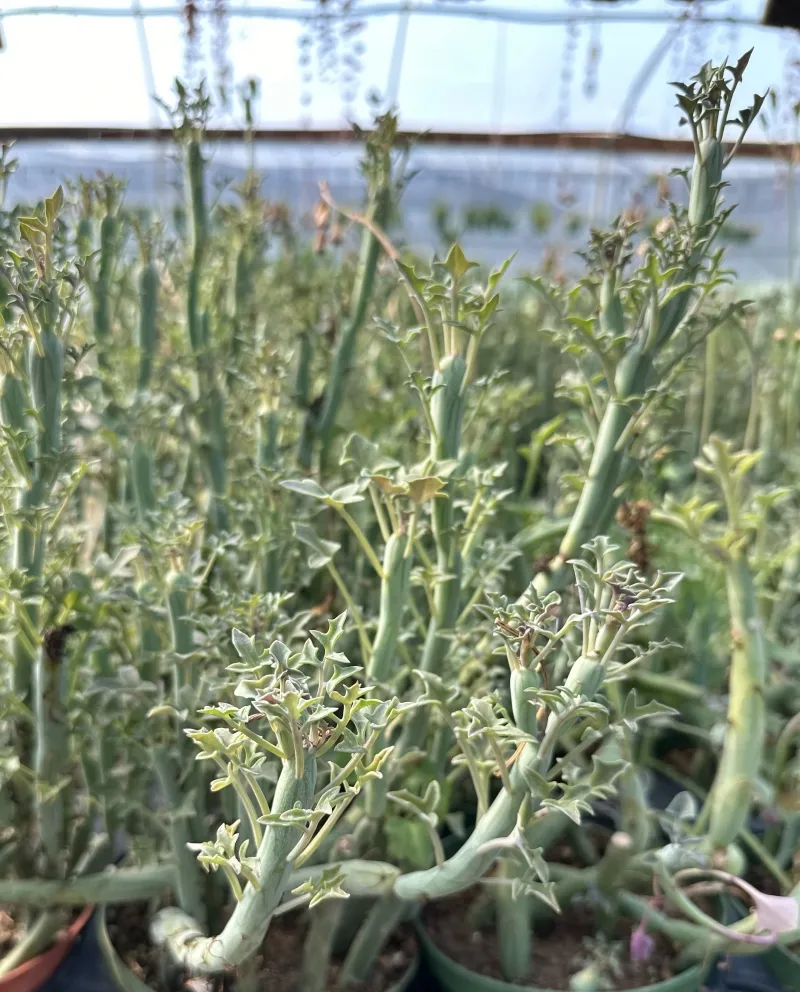
Quirky jointed succulent grows ivy-like leaves until water is withheld or heat comes on. Suckers to create a colony of ice blue stems that is dense in sun or meandering in shade.
 Synonyms Synonyms | Senecio articulatus |
|---|---|
 Height Height | 6–16in |
 Width Width | 8–20in |
 Tolerates Tolerates | Drought, Pots |
 Water needs Water needs | Low – Moderate |
Most succulents are from the deserts of the world and as such like to go totally bone dry between waterings, making them very low-maintenance. This senecio comes from an area with winter rainfall and is actively growing during that time, when it is forgiving of overwatering errors. During summer dormancy it should be kept extra dry and will not tolerate overwatering. It's normal for this plant to defoliate during that time. You'll notice that this plant has a waxy coating on the stems, an adaptation that makes it very efficient at storing water and thus living on extended drought. Remember that if kept in a small pot your plant will want more frequent watering. | |
 Hardy to Hardy to | 26°F |
 Exposure Exposure | Part Sun – Full Sun |
 Plant traits Plant traits | Deciduous, Rock Garden, Succulent, Suckering |
 Indoor / outdoor Indoor / outdoor | Indoor or Outdoor |
 Drainage Drainage | In Ground: Cactus Mix, In Pots: Cactus Mix, Tolerates Sandy Soil |
 Fertilizing Fertilizing | All Purpose |
 Origin Origin | South Africa |
 California native California native | No |
 Sunset zones Sunset zones | 16, 17, 19, 21–24, H1, H2 |
Growing Notes
When grown 'hard' in small pots, more sun, or with less water, this plant gets short almost bead-like segments. These resemble a string of sausage links. When given ample water, a bit of shade and fertilizer it grows longer, wandering stems.
Can be grown in a small pot for a very long time. Repotting once totally root bound is recommended. This plant makes subterranean tubers that it uses to replicate below the ground level. These are easily repotted to propagate new plants.
If grown in Sunset zones 16 or 22 this plant will want some protection, such as growing against a wall of the house, or up on a deck where it's protected from frost.
Links
The above information reflects the observations of Grubb and Nadler and our extended plant community. We always consider input from fellow horticulturists and welcome feedback from those with additional information on the culture of this plant.
© 2020–2026 Grubb and Nadler. All rights reserved.