
Opuntia ficus-indica ‘Burbank Spineless’
Burbank's spineless nopal
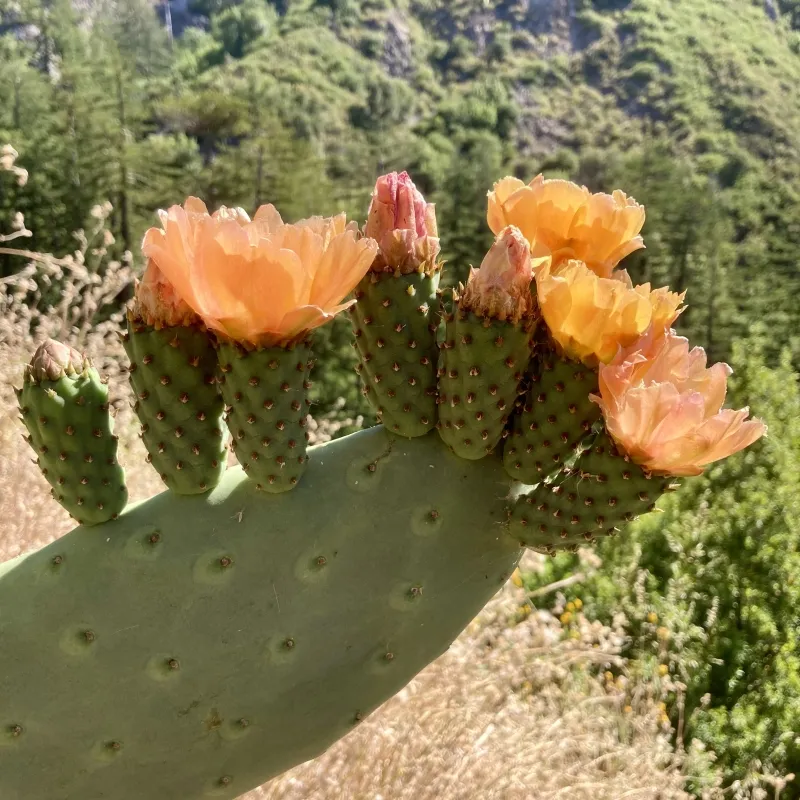
Large prickly pear with upright form and nearly spineless, elongated paddles. Tangerine summer flowers followed by tasty red fruits. Edible paddles. A stylish addition to the edible garden.
 Height Height | 5–12 |
|---|---|
 Width Width | 6–10 |
 Tolerates Tolerates | Drought, Heat, Pots |
 Water needs Water needs | Low |
Opuntia are extremely drought-tolerant, which means that no additional water should be needed once the plant is established. Newer plants might show that they are thirsty when their leaves begin to shrivel. If this happens, give them a bit of water; otherwise they might start to drop their paddles. Often these shed paddles will root and grow once rain comes. To keep your opuntia plump and lush-looking, water it every two or three weeks during the summer. Opuntias prefer good drainage, but they are tolerant of a wide range of soils. | |
 Hardy to Hardy to | 23°F |
 Exposure Exposure | Full Sun |
 Plant traits Plant traits | Bees, Cactus, Edible, Humming Birds, Sculptural, Trunking |
 Indoor / outdoor Indoor / outdoor | Outdoor |
 Drainage Drainage | In Ground: Cactus Mix, In Pots: Cactus Mix, Tolerates Sandy Soil |
 Fertilizing Fertilizing | All Purpose, Low Needs |
 Origin Origin | hybrid |
 California native California native | No |
 Sunset zones Sunset zones | 8, 9, 12–23 |
Growing Notes
Opuntias (prickly pear or paddle cactus) are iconic and have a myriad of uses. This one has edible paddles called nopales and edible fruit called tunas. These cactus can be pruned by selectively removing paddles to accentuate a more upright, open, or bushy form. Opuntias are delicate, and arms snap off easily, so be sure to keep them away from high traffic areas. These arms can easily be propagated, by laying them on their sides on cactus mix.
You will find your cactus develops hard brown scabs that eventually cover the cactus, especially on older growth. This is called corking, and is the natural process of the cactus 'branch' becoming a cactus 'stump' and getting bark, just like trees do. Corking is totally natural and adds to the beauty of your cactus as it becomes more treelike.
These larger, more upright Opuntias will develop a meandering trunk over time as their paddles gradually cork and are covered with rough bark. By pruning the paddles over time, you can sculpt your trunk(s) and primary branches into the desired form.
Special Interest
Early in the nineteenth century Luther Burbank hybridized this South American opuntia, intending to make a drought tolerant cattle fodder for the Southwest. Ironically, over a hundred years later it's consumed by more people than cows!
Some report that this is a hybrid of the species Opuntia Ficus-indica and Opuntia tuna.
The above information reflects the observations of Grubb and Nadler and our extended plant community. We always consider input from fellow horticulturists and welcome feedback from those with additional information on the culture of this plant.
© 2020–2026 Grubb and Nadler. All rights reserved.