
Romneya coulteri
Matilija poppy
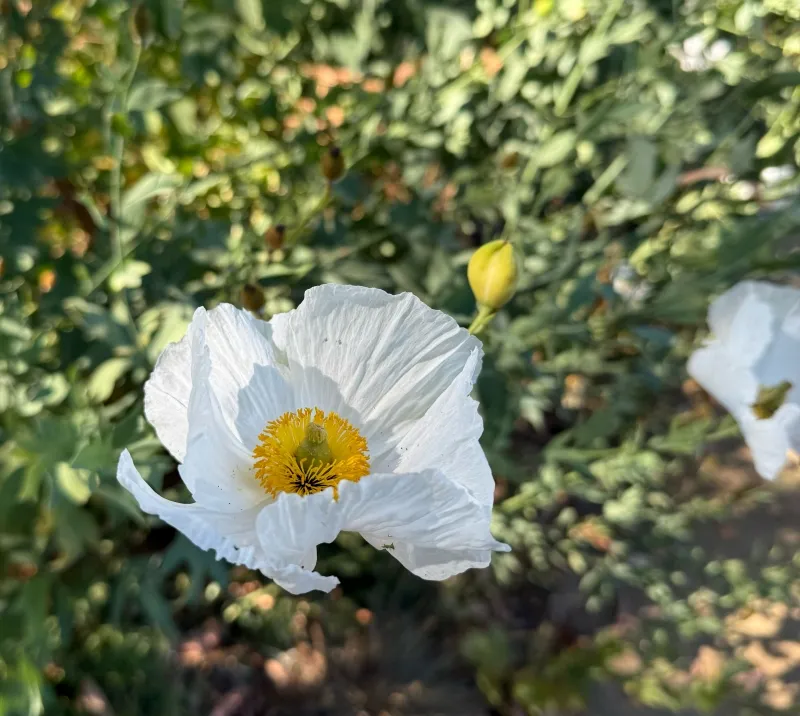
California's biggest wildflower is a very tall perennial poppy, semi-evergreen, long-blooming, with "fried-egg" flowers (crinkled white petals, yolk-yellow stamens). Dry-tolerant, tenacious.
 Synonyms | Romneya trichocalyx |
|---|---|
 Height | 4–8ft |
 Width | 2–25ft |
 Tolerates | Coast, Cold, Cool Summers, Heat, Wind |
 Water needs | Low |
Being a California native from dry hillsides, this plant is very drought tolerant and will survive without water once established, given the right position and winter rainfall. That said, it looks its best and blooms longer with deep intermittent waterings during hot dry months. Water Matilija poppy infrequently, when the top three inches of soil feel dry. Usually this will mean every week or two in dry weather. If you establish this pattern over a couple of years, then you can cut back to watering every four to six weeks in dry weather or possibly even not at all (let your plant take the lead). Use drippers, emitters, or a slow stream of water so that it does not run off; allow the water to trickle all the way down through the deepest layers of soil. In a pot slowly water the entire surface until water comes out of the bottom of your pot. This plant, unlike some plants from our native chaparral, is also adaptable to regular water, given good drainage. | |
 Hardy to | 0°F |
 Exposure | Part Shade – Full Sun |
 Plant traits | Bees, Butterflies, Cottage, Flowering, Spreading, Suckering |
 Indoor / outdoor | Outdoor |
 Drainage | In Ground: Cactus Mix, In Pots: Potting Soil, Tolerates Heavy Soil, Tolerates Sandy Soil |
 Fertilizing | Low Needs |
 Origin | Southern California |
 California native | Yes |
 Sunset zones | 4–11, 14–24, H1 |
Growing Notes
Cut back in winter to keep tidy. New stems will develop early in spring and reward you with spectacular bloom later in spring and summer.
Romneya is slow to establish. Planting in fall or winter helps. Treat the roots gently when planting. Once established, however, it is one of the most aggressively running plants, suitable for large naturalistic areas or for beds with bamboo barriers. It also can perform in a large pot. Make sure rhizomes do not sink into underlying soil through the drainage holes.
Special Interest
One of the easiest and most spectacular California-native flowering plants. Many individuals are surprisingly fragrant.
The flowers are attractive to bees, birds and butterflies.
To enjoy in a vase, cut in the bud stage and sear the cut end of the stem with a flame. Flowers will open and last a few days at most but are worth the effort.
San Marcos Growers says: "The common name Matilija Poppy comes from an area in Ventura County, Matilija Canyon, where this plant is abundant [and] that was named for Chief Matilija of the Chumash Indian Tribe. The Chumash Indians used the sap of this plant to make a drink and for medicinal purposes."
Links
In stock today in San Francisco
| 3 gallon | 6 available | $49 |
The above information reflects the observations of Grubb and Nadler and our extended plant community. We always consider input from fellow horticulturists and welcome feedback from those with additional information on the culture of this plant.
© 2020–2026 Grubb and Nadler. All rights reserved.