
Butia eriospatha
woolly jelly palm
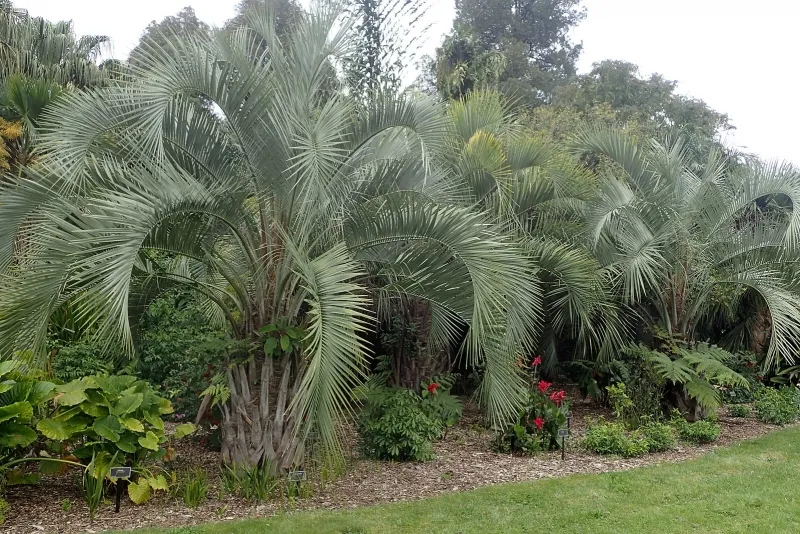
Steadily growing, modest-size palm bears unusual blue to blue-green recurved leaves. Stronger form than B. odorata, even more cold-hardy.
 Height | 12–20ft |
|---|---|
 Width | 10–15ft |
 Tolerates | Cold, Cool Summers, Drought, Wind |
 Water needs | Low – Moderate |
This palm should be watered deeply every week or two once it's established. It doesn't want to ever dry out completely. | |
 Hardy to | 13°F |
 Exposure | Full Shade – Full Sun |
 Plant traits | Edible, Ornamental Fruit, Palm, Solitary, Tropical, Trunking |
 Indoor / outdoor | Outdoor |
 Drainage | In Ground: Cactus Mix, In Pots: Cactus Mix, Tolerates Sandy Soil |
 Fertilizing | Palm Fertilizer |
 Origin | S Brazil |
 California native | No |
 Sunset zones | 5–9, 14–24, H1 |
Growing Notes
Prune off older leaves as they decline, cutting the leaf petiole as close to the trunk as possible.
Reputed to be faster growing than other cultivated Butia species.
This species originates from higher altitudes (700 meters to 1200 meters above sea level) in southern Brazil (Parana, Santa Catarina, and Rio Grande do Sul states) and promises to be even more tolerant of cool summers than the more common B. odorata.
Special Interest
While this Butia looks similar to odorata (capitata) it is distinguished by the more architectural, symmetrical fronds, and characteristic fuzzy flower spathes; this is the reason it was given the species name eriospatha (erio meaning wool and spatha describing the swordlike shape of the structure that encloses and protects the palm's developing flowers).
Like Butia odorata, the fruit is edible and can be tasty, if fibrous.
More Info
Our plants come from the current owners of the East Bay garden established by the late Inge Hoffmann, the "Seed Lady" who distributed thousands of palm seeds around the world from the 1980s into the 2000s, first for the International Palm Society Seed Bank, and then through her own business.
Links
In stock today in Los Angeles
| 1 gallon | 7 available | $24.95 |
The above information reflects the observations of Grubb and Nadler and our extended plant community. We always consider input from fellow horticulturists and welcome feedback from those with additional information on the culture of this plant.
© 2020–2026 Grubb and Nadler. All rights reserved.