We can grow many kinds of palms in our coastal California gardens — palm trees, shrubby palms, bamboo palms, little foliage palms — lucky us! Flora Grubb Gardens grows and sells dozens of varieties of rare and exceptional palms. We offer palms you won’t find anywhere else.
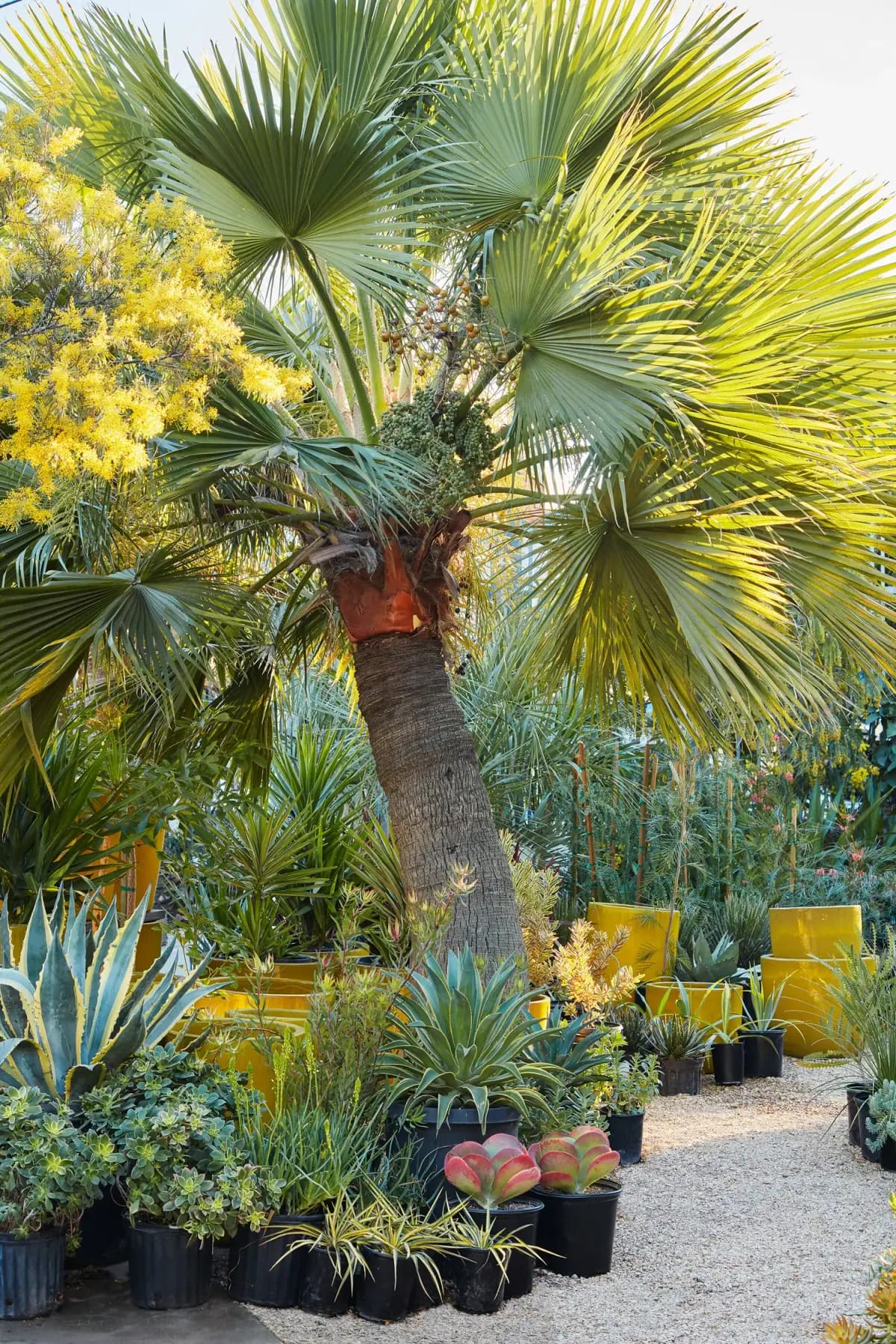
Brahea edulis, the Guadalupe palm, at Flora Grubb Gardens in San Francisco
OUR FAVORITE PALMS
Chamaedorea plumosa (baby queen palm)
The baby queen palm is the fastest-growing, most adaptable, and best-scaled palm for small gardens. This delightful native of Chiapas, Mexico, tolerates light frosts, deep shade or nearly full sun, and wind, among other bugaboos of coastal gardening. Its fluffy leaves quickly rise on a thin green stem to create a languorous, weeping crown in deep shade. It appreciates ample water and fertilizer, but, once established, it will tolerate dry periods. Shoehorn it into narrow light wells, or plant it out to give vertical definition in broad, exposed spaces. In the windiest and coldest districts, plant in a protected lee spot, but otherwise it’s adaptable to most urban and coastal California climates (Sunset zones 16-17, 21–24 ).
Max height: 20 feet in 15 years
Max spread: 3 feet
Small palm for small gardens and tight spaces, versatile, fast-growing
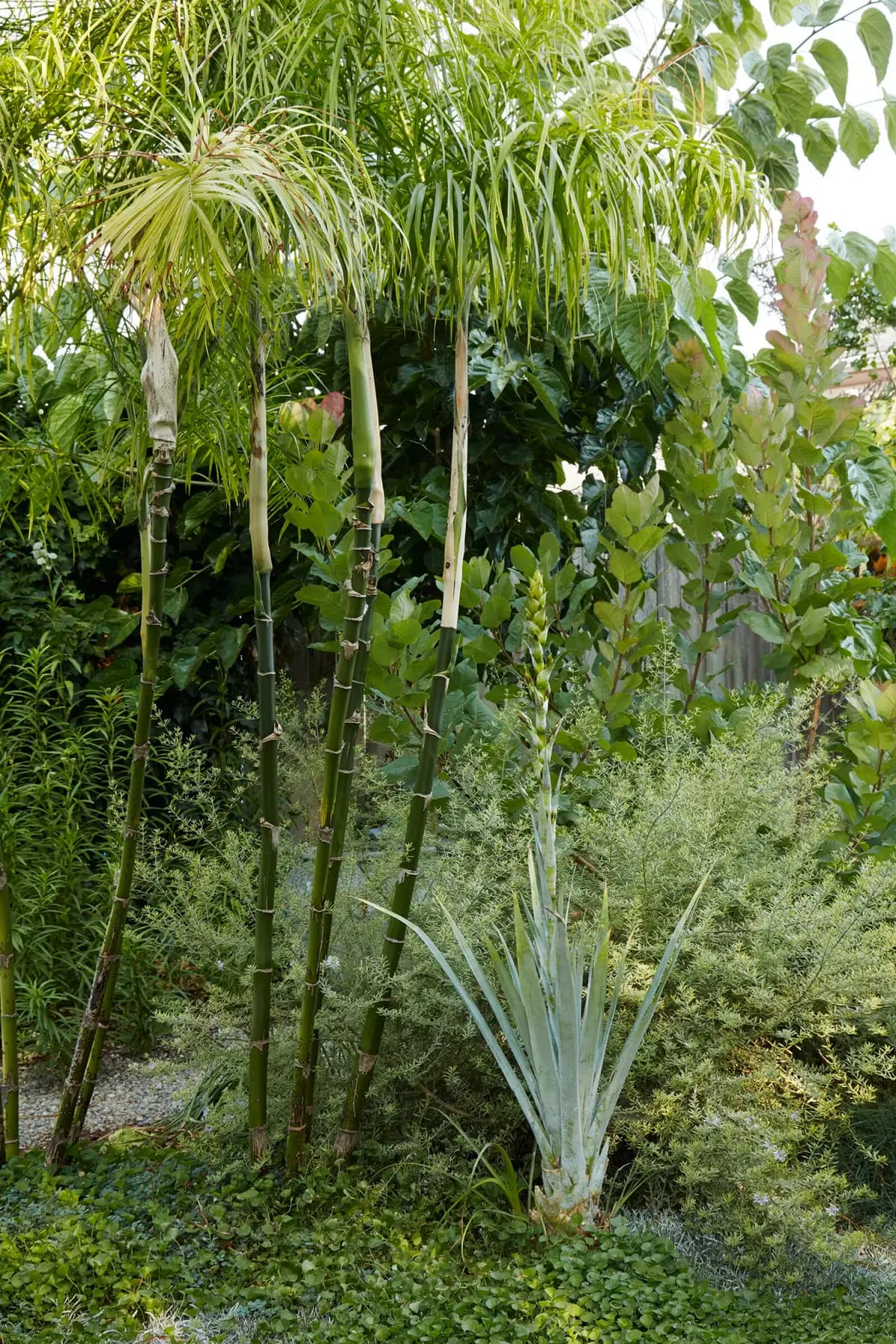
Chamaedorea plumosa in Flora Grubb’s Berkeley garden.
Chamaerops humilis (Mediterranean fan palm)
The Mediterranean fan palm is the most versatile species for California and in any landscape that stays above 15F most winters and can offer reasonably good soil drainage. Prune as a shrub, single palm tree, or cluster of paradise-island trunks. It’s one of the toughest plants for coastal, valley, and desert gardens alike, enduring long stretches of drought once established, shade, sun, wind, containers, and salt spray. The newer variety, C. humilis var. argentea, offers a silvery, waxy leaf on a slower-growing, hardier, smaller plant.
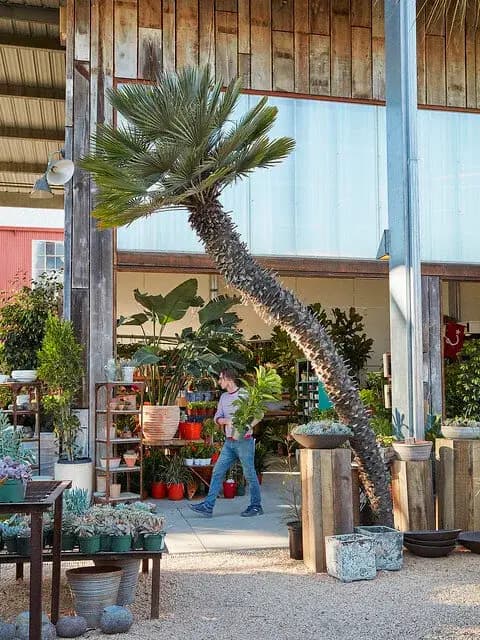
Chamerops humilis, the Mediterranean fan palm, at Flora Grubb Gardens, San Francisco
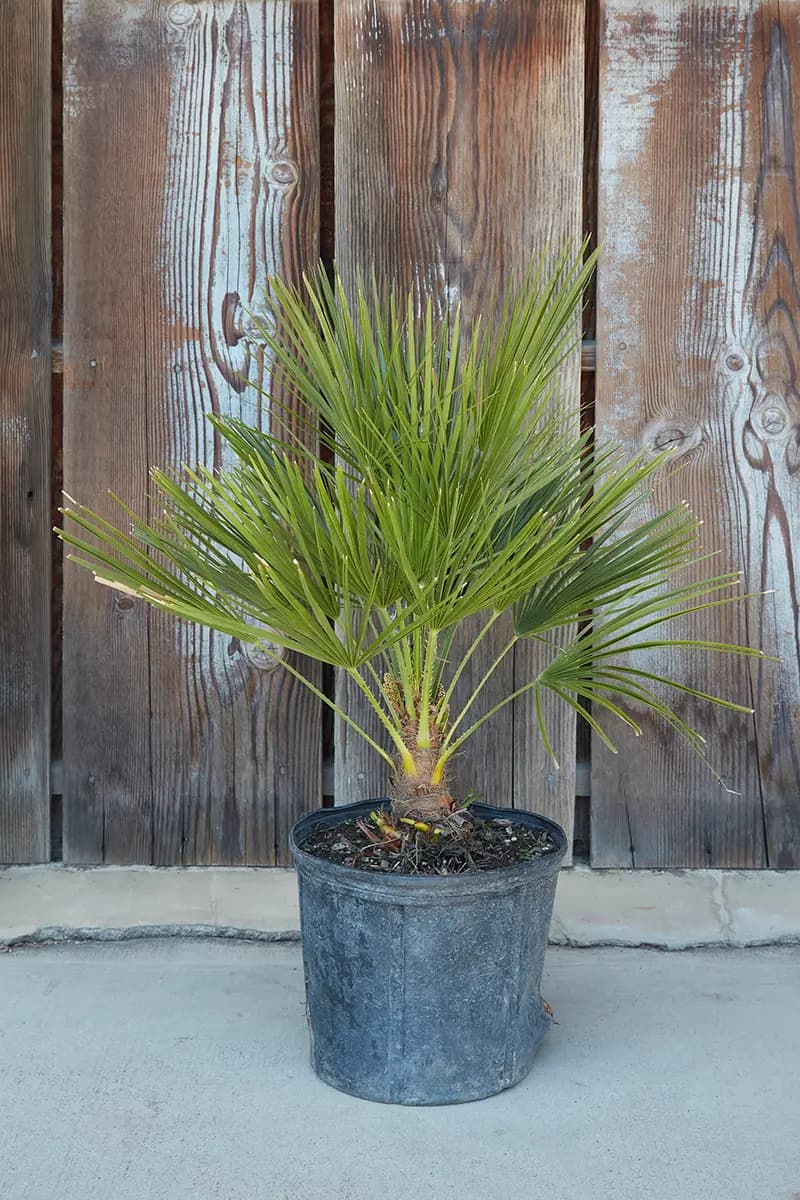
Chamaerops humilis at Flora Grubb Gardens
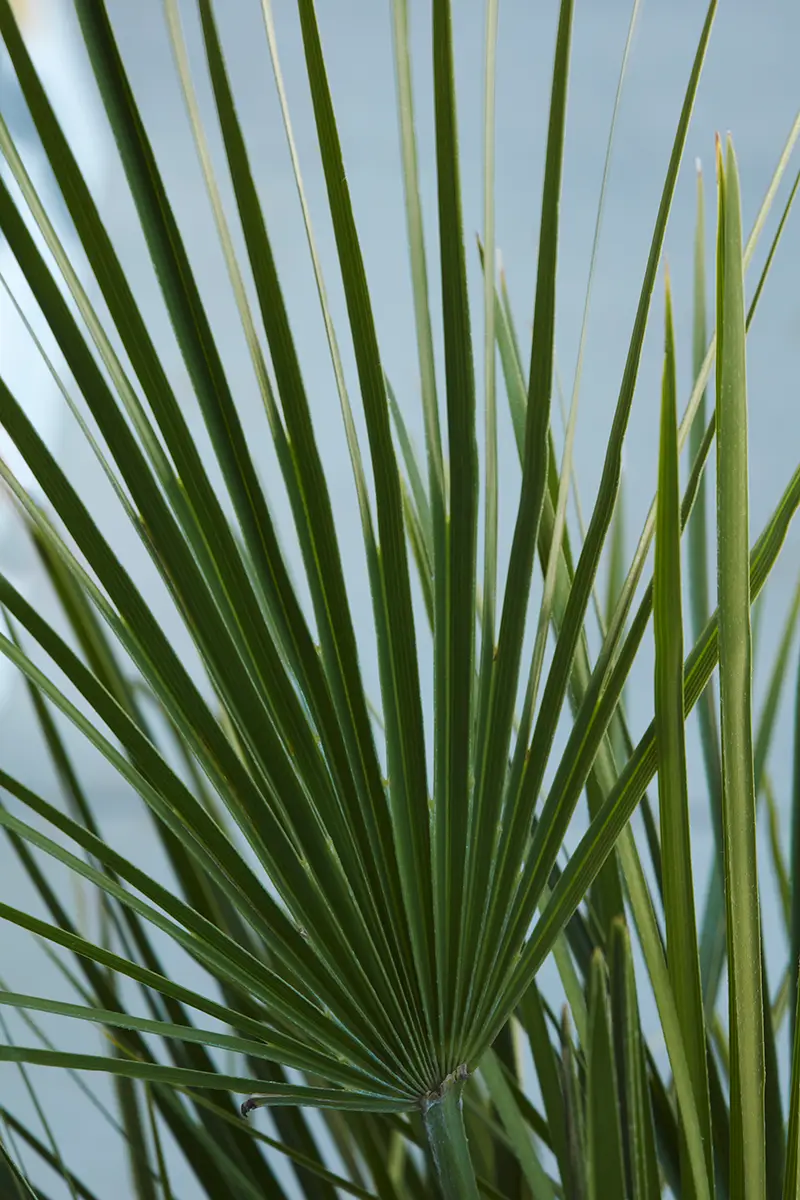
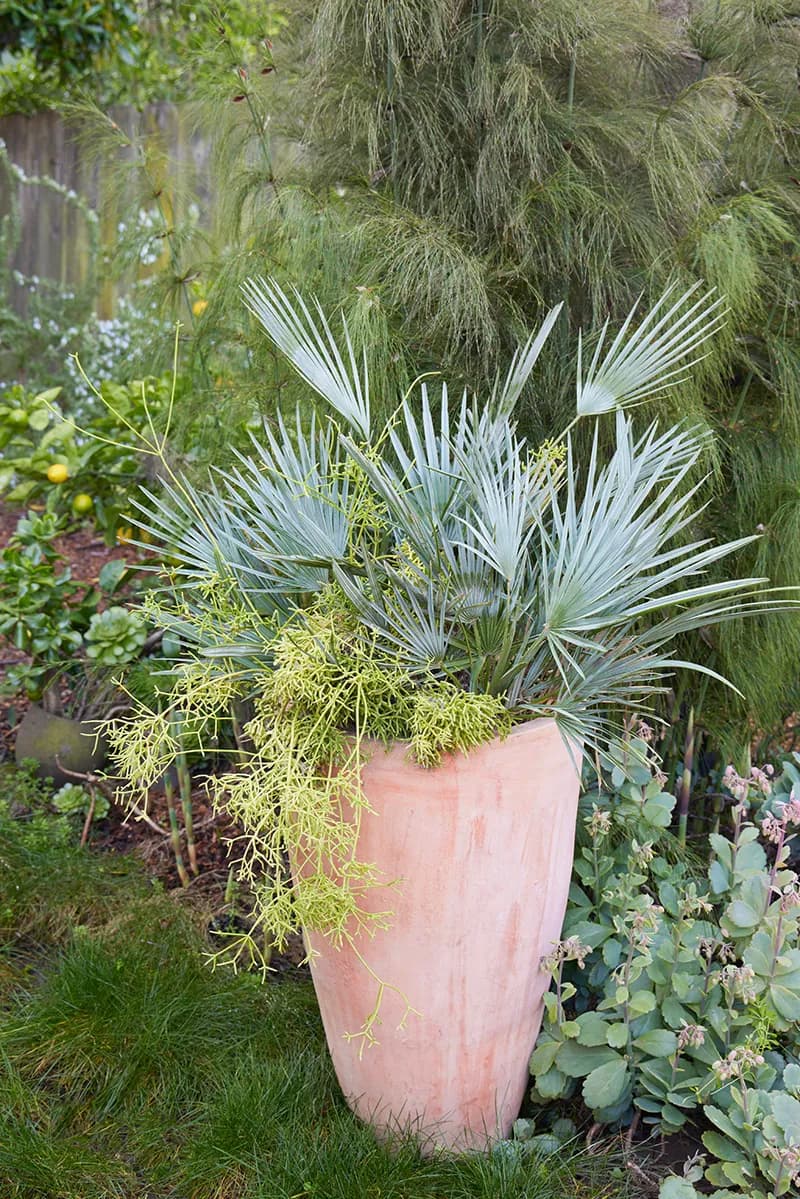
Chamaerops humilis ‘Cerifera’ (silver Mediterranean fan palm / blue Atlas fan palm)
Rare, elegant, and tough as nails, this silver form of the Mediterranean fan palm from the Atlas Mountains of Morocco and Algeria has powder-blue leaves. It’s a slow-growing, suckering palm that thrives in pots or in the ground. Once established it takes drought, heat, wind, salt, deer, rooftops, and neglect, and it’s one of the hardiest palms we grow. We grow it from seed on our farms. Thin the old inner leaves for a cleaner look. Hardy to 5F.
Trachycarpus fortunei (Chinese windmill palm)
The Chinese windmill palm can tolerate drought, wind, and some neglect, but at the expense of looking trashy and parched. The best-looking Chinese windmills get even moisture, some shade when young, and fertilizer that includes magnesium and potassium. They also benefit aesthetically from group planting and you can give them an updated look by pruning off the furry leafbases. Consider using its cousins Trachycarpus wagnerianus, Trachycarpus takil, and Trachycarpus latisectus, as well. When used as a street tree, it tends to look best in multiples: two or three per well, or several in a row. Good in a pot, too.
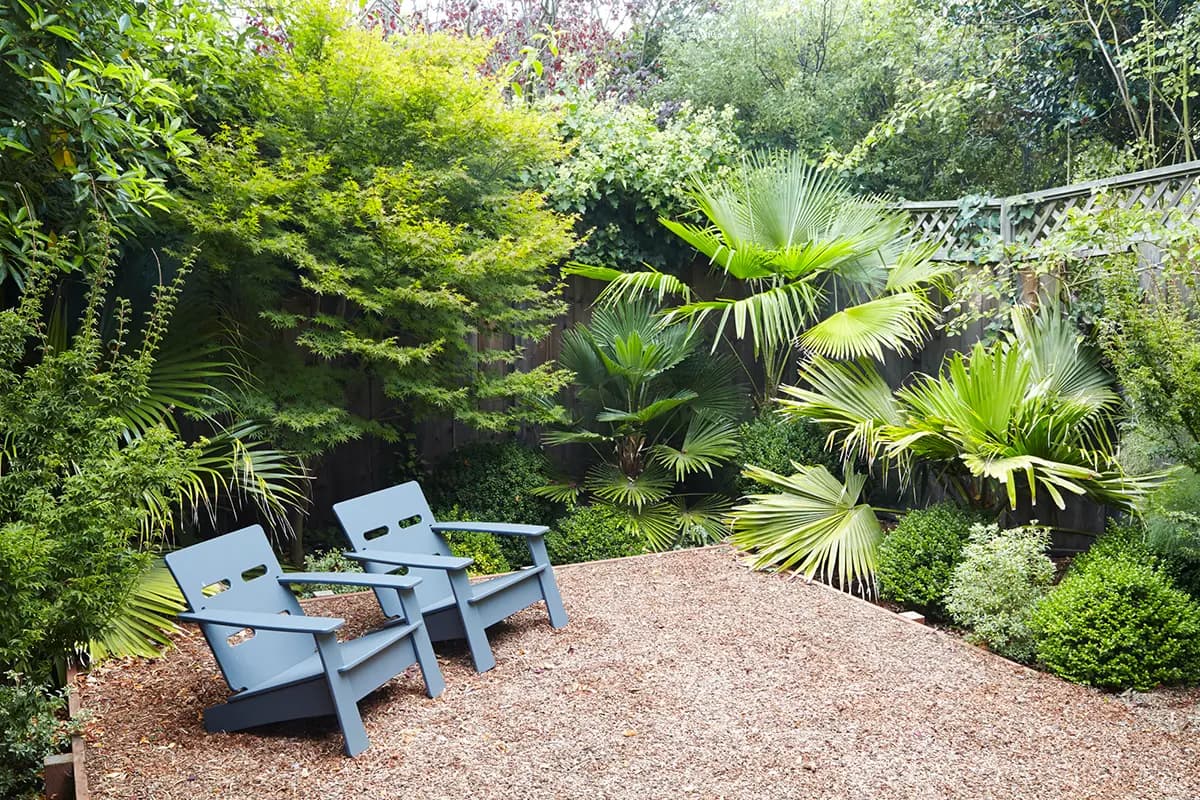
Trachycarpus palms with their majestic fan-shaped leaves
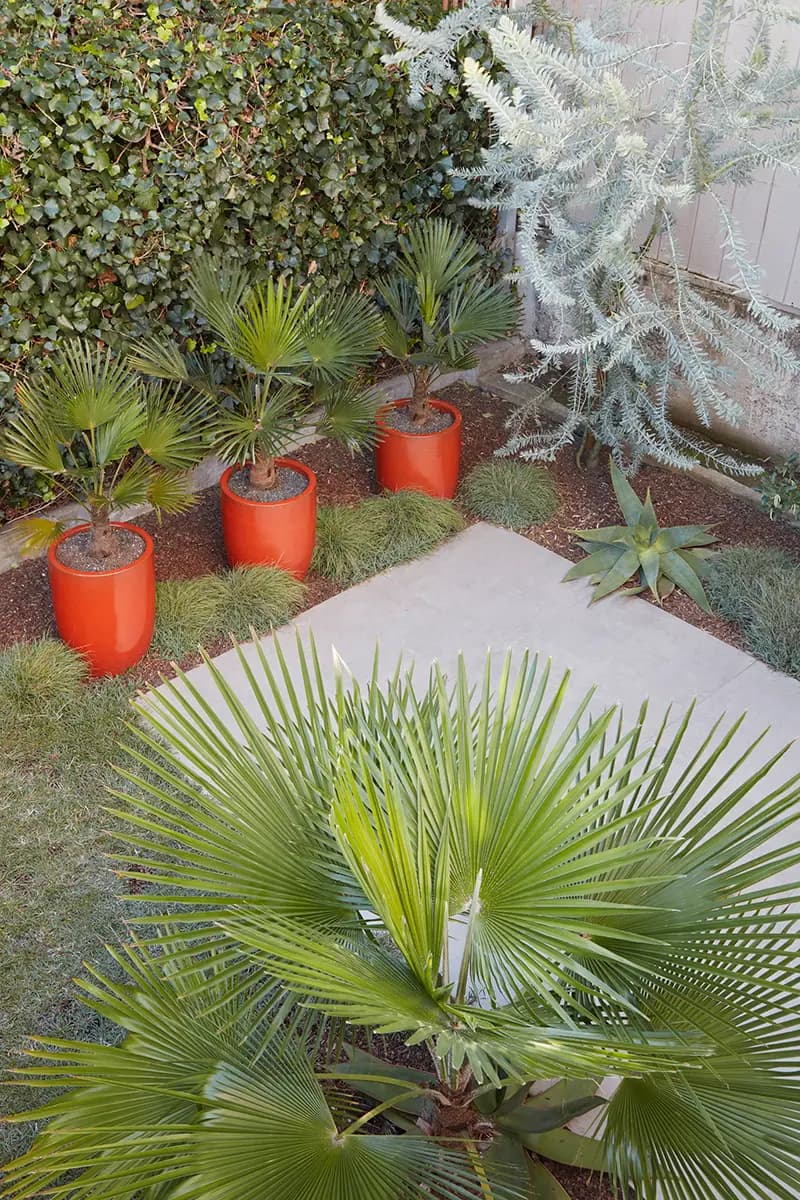
Trachycarpus palms are a great choice for pots
Rhapis excelsa (lady palm)
The lady palm makes an elegant, small bamboo-like clump. Slow-growing, it prefers shade and year-round moisture, and in NorCal it grows best away from the ocean. An excellent container plant, it’s also nice as a small-scale shade hedge and as an accent against a wall. Give it protection from wind and from temperatures below about 23F. Thin trunks covered in a rustic fabric-like texture can be groomed to reveal smooth bamboo-like pattern. Its cousin, Rhapis multifida, offers a finer texture and more delicate habit and requires similar conditions, tolerating somewhat lower winter temperatures.
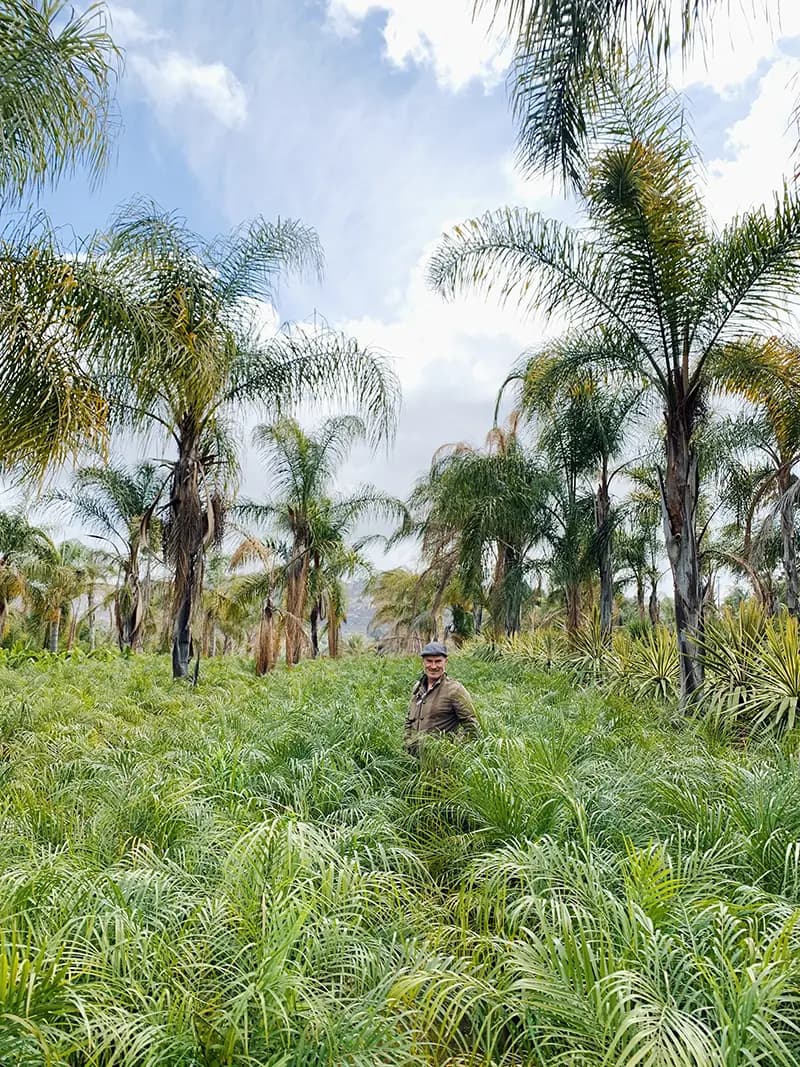
Palm expert Jason Dewees among the pygmy date palms at our farms at Grubb & Nadler
Phoenix roebelenii (pygmy date palm)
The pygmy date palm from southern China and northern Laos grows into a mini palm tree and thrives wherever temperatures stay above 26F. (In Northern California, it’s best away from the seaside.) Best with summer irrigation. Slow-growing, it’s a pretty foliage plant before it develops its trunk, and it’s happy growing forever in a pot. Looks great planted in clusters and tolerates both full sun and bright shade.
Archontophoenix cunninghamiana (king palm)
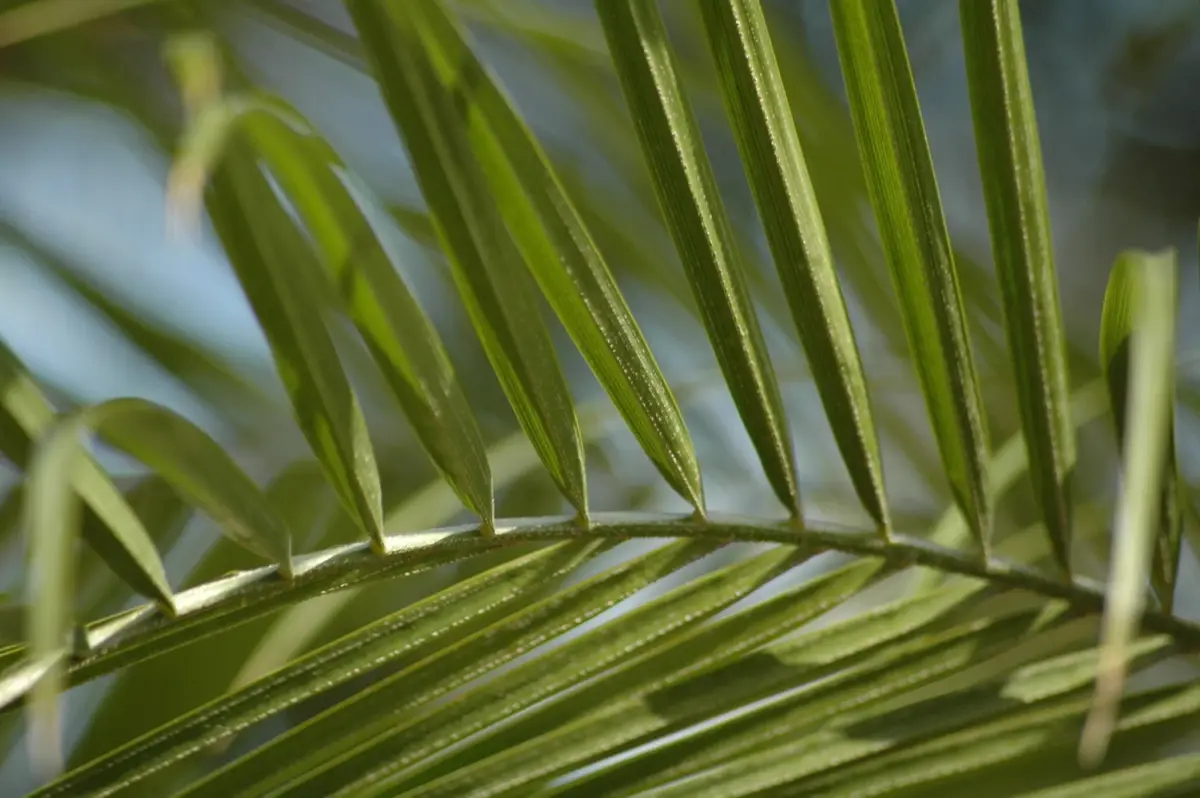
The king palm grows well in wind-protected areas that experience minimal frost and where moisture and fertilizer can be provided. It’s at its best where winter temperatures stay above 30F and summer highs consistently surpass 70F—almost everywhere in Southern California besides the hot desert and colder canyons. In cooler areas it performs well in sunny spots, but not in windy, foggy areas like at the beach. In Northern California, we see beautiful king palms in milder, warmer spots like Oakland. Good as a street tree if irrigated. Particularly nice planted in clumps. Not recommended for long-term container culture.
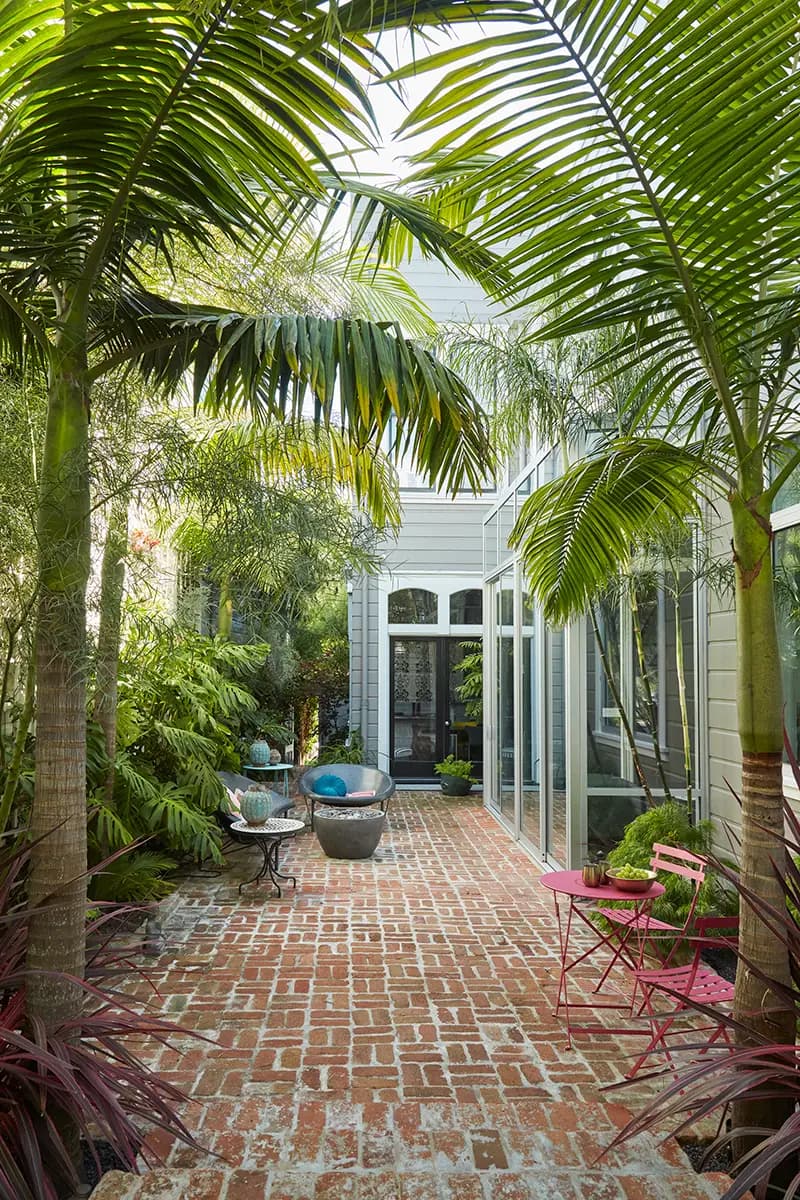
Archontophoenix cunninghamiana (king palm) creates a beautiful frame in this SF backyard designed by Christopher Reynolds.
Brahea edulis (Guadalupe palm)
The Guadalupe palm, a native of Guadalupe Island off the Pacific Coast of Baja California, succeeds like a California native in coastal and valley climates. It thrives in sun or shade, wind, with minimal summer water, at the beach or inland, and can be kept indefinitely in a container. Whether solitary or in groves, it provides a friendly garden canopy. Excellent street tree—as long as fruit clusters are removed annually. It sheds its spineless leaves once they turn brown, revealing an elephantine, striated trunk. Moderate in growth speed, it reaches a max height of 30 feet in 60 years. Pale creamy-green flower stalks are followed by green fruits the size of large olives. 18F minimum temperature; avoid spray irrigation on the trunk or crown. Not at its best in the desert.
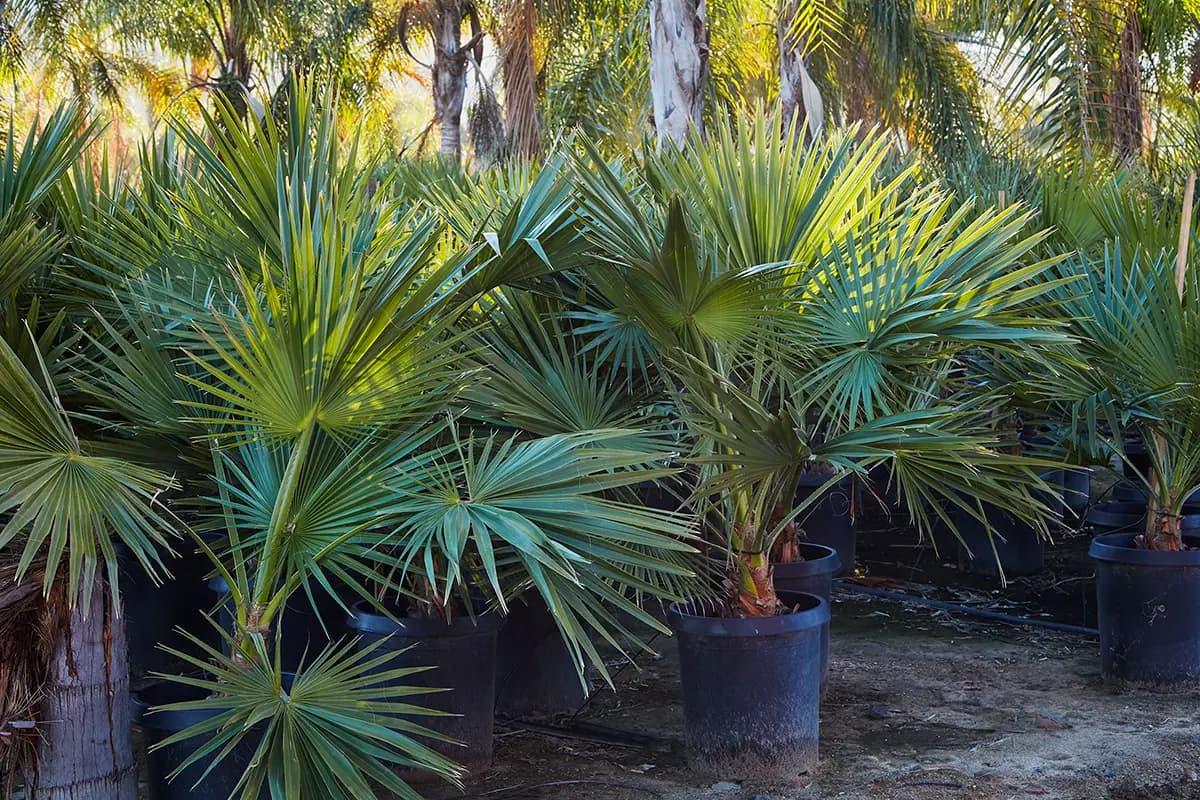
Gorgeous Brahea edulis (Guadalupe palm) crop in our growing grounds at Grubb & Nadler in Fallbrook, CA
Chamaedorea hooperiana (Hooper’s bamboo palm / Maya palm)
This relaxed-looking bamboo palm is a treat for small gardens and bigger properties alike. It is a moderately fast-growing, adaptable native of Veracruz, Mexico, that tolerates light frosts, deep shade or part sun, and some wind. Its elongated, arching leaves quickly rise on a thin green stems that look like bamboo. Suckers lean out from the base and expand the plant into an open, bamboo-like cluster, occasionally producing showy black fruit on orange branches. It appreciates ample water and fertilizer,. Once established in cooler coastal areas, it will tolerate lower irrigation. Place it behind a seating area to add a loungey vibe, or plant it in lines and clusters for an informal shade hedge. Use it as a tidy substitute for bamboo—minimal leaf drop reduces the need to sweep patios and pathways. In the windiest and coldest districts, plant in a protected lee spot, but otherwise it’s adaptable to many urban and coastal climates (Sunset zones 16-17, 21–24).
Max height: 12 feet in 15 years
Max spread: 8 feet
Compared to Hooper’s bamboo palm, the hardy bamboo palm is smaller and more upright and tolerates more sun and more frost. It’s best away from the Northern California fog belt but can be grown in frostier areas than its cousin. Great in containers and nice bright-orange fruit.
Chamaedorea pochutlensis and C. costaricana
Compared to Hooper’s bamboo palm, these bamboo palms are faster-growing, denser, and more upright, with thicker, lusher foliage. They thrive in coastal zones and in frost-protected gardens inland. Also great in a pot.
Syagrus romanzoffiana (queen palm)
The queen palm is a good choice for a fast-growing, narrow, medium-sized palm tree everywhere in Southern California but the low desert and cold mountains. In NorCal they’re best where summers are slightly warmer than the coast. Provide moisture and fertilizer to get them off to a strong start and periodically thereafter. A good street tree. Quite nice in shade as well as sun. Looks best with fertilizer and where winter temperatures stay above 25F and summer highs consistently surpass 70F.
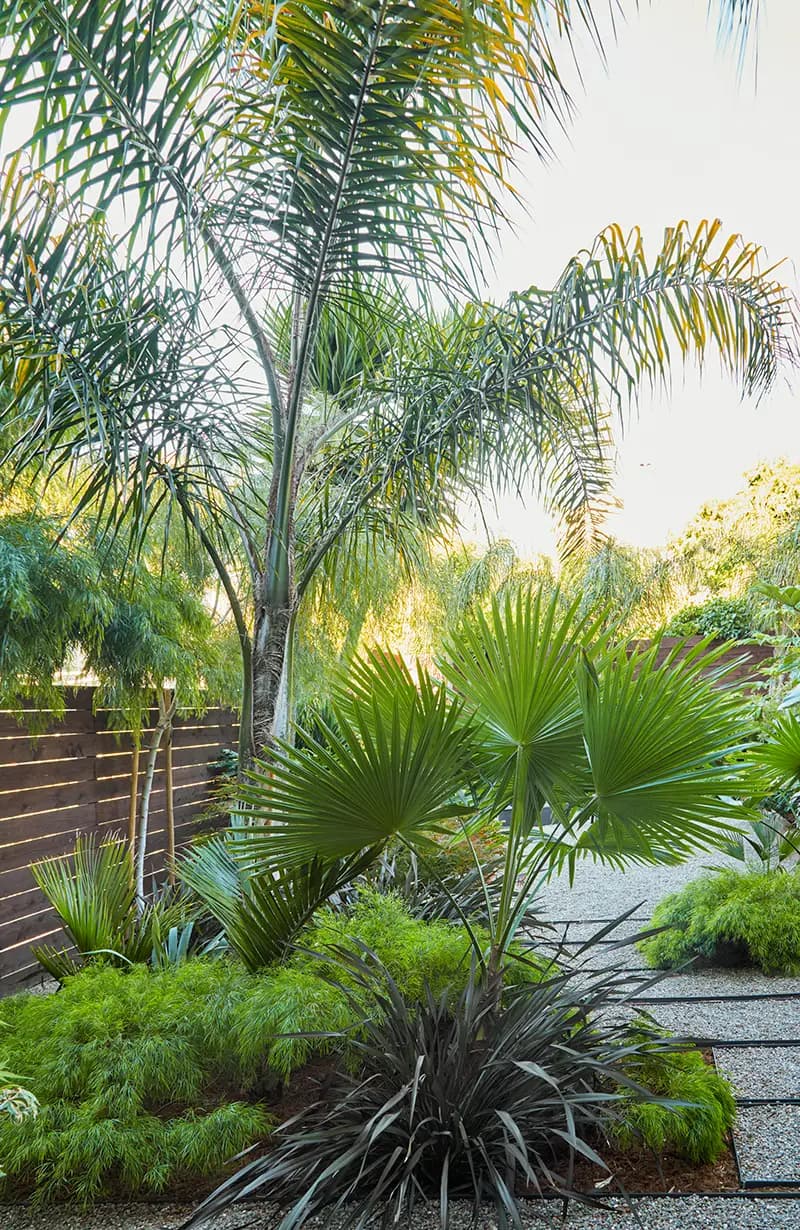
Syagrus romanzoffiana (queen palm), the tall palm in the background here, is a versatile beauty.
Rhopalostylis sapida (nikau palm)
The nikau is New Zealand’s native palm, and like its fellow native plants, it does exceptionally well in coastal climates where winters remain above 27F, especially in cooler, foggier areas near the ocean and bay. A moderate-size, moderately slow-growing palm tree (to 30ft in 50 years), its smooth green trunk and stiff, upright crown of foliage make a dramatic, architectural statement. Fascinating purplish flower clusters are followed by tiny red fruits. Best started in a shady spot, it will grow up into sunshine happily over time, and established plants can tolerate moderate coastal exposure. Make sure to supply consistent summer irrigation. Its narrow crown fits into surprisingly tight spaces.
Rhopalostylis baueri (Norfolk Island palm)
A close cousin of the Nikau palm, the Norfolk Island palm offers a softer, more tropical and more colorful look, slightly faster growth, and higher light tolerance when young. It’s less frost-tolerant. Both species are exceptionally pretty foliage elements as juveniles in shade and both can live for many years in containers.
Butia odorata (pindo palm / jelly palm)
The pindo or jelly palm from Uruguay and south Brazil is an exceptionally versatile and adaptable plant, suited to coastal gardens as well as hot, inland places. With its leaves recurving down over the lip of a pot, it makes a perfect container specimen. In the ground it slowly becomes a modest-size palm tree (to 20 feet in 50 years) in sun or shade, developing drought tolerance with age. Showy flower stalks pop out of dramatic baseball-bat-like bracts popular with floral designers. Fruits that follow ripen to yellow-orange and can be delicious and made into preserves, as befits its common name. Use it anywhere temperatures stay above 15F and soil is reasonably well-drained. Its hybrid with the Chilean wine palm, Butia x Jubaea, offers a larger size tree with a more structured crown of foliage and equal or greater drought and cold tolerance.
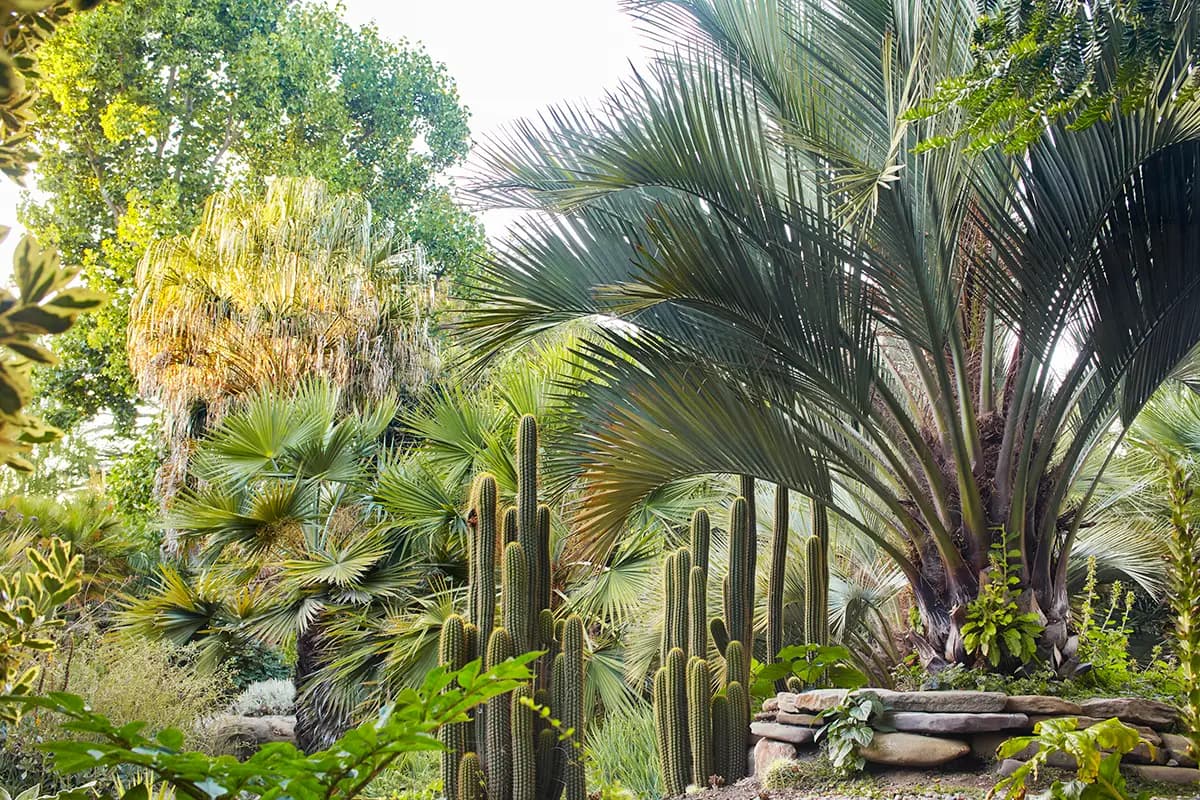
Butia odorata (right foreground)
Washingtonia robusta (Mexican fan palm)
Classic street and skyline tree of California, the Mexican fan palm and the unbeatable “cockroach” of palms, grows fast and looks good in a wide array of conditions. It will tolerate but not look good in the chilly fog belt, while it will thrive but get occasional winter foliar damage in the coldest inland climates. Widely available, it grows fast and gets quite tall (50 feet in 50 years). (We do not offer its cousin and our native California fan palm, Washingtonia filifera, because it does not do well in coastal California; it’s best suited to hot inland areas like its desert home.)
Phoenix dactylifera (true date palm)
Selections of the true date palm, ‘Zahidi’ and ‘Medjool,’ tolerate cooler, humid summers better than the skinnier ‘Deglet Noor.’ True date palms can also replace Canary Island date palms where specimens are needed, offering similar size but a more open, spare appearance. Tall specimens make good street trees.
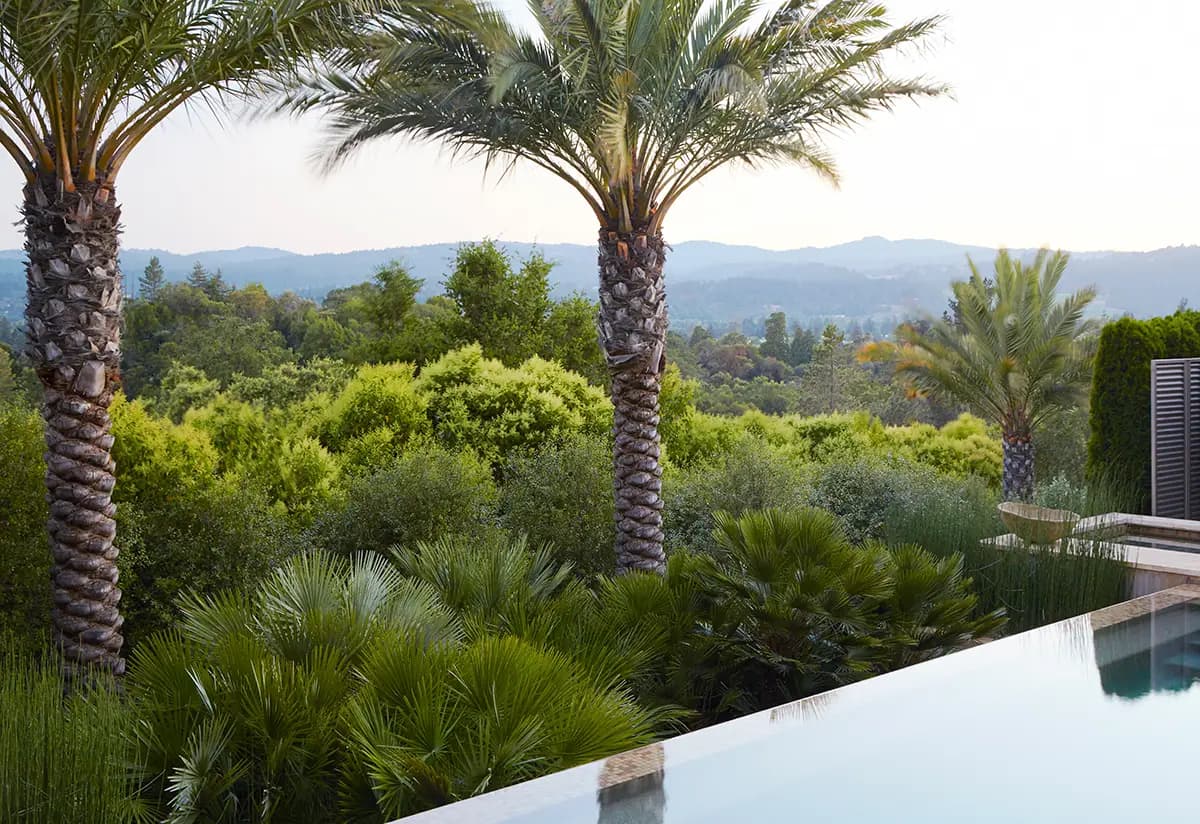
Phoenix dactylifera ‘Zahidi’ (true date palm) in a wine country poolside landscape
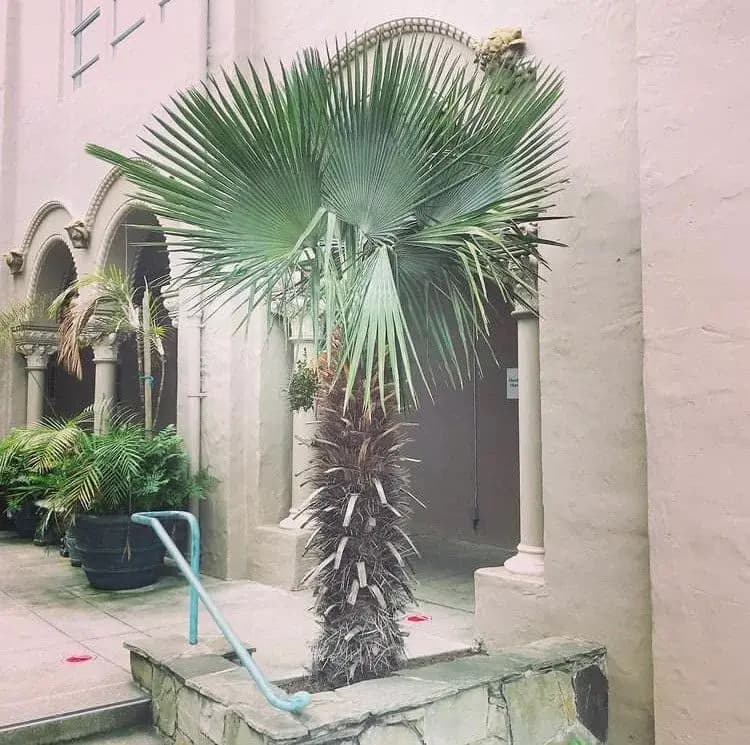
Trithrinax acanthocoma (Brazilian needle palm)
Very handsome, medium-sized and solitary, the Brazilian needle palm is drought tolerant and thrives in varied conditions, from shade to sun. It has the superpower of tolerating clay soil (though like all palms, it prefers well-drained soil) and can even tolerate temporary flooding. Trithrinax acanthocoma is also hardy, and not just a little bit, with plants surviving temperatures down to 15F. Probably the most distinguishing characteristic is the neatly woven fiber trunk, bristling with long spines. Worried someone might climb your palm trunk to hop that back fence? Well, not with this palm! Its profuse white flowers and ivory fruits are seasonal stunners, too. Be sure to add this unique and durable palm to your desert cactus garden or subtropical city jungle. (Sunset zones 8, 9, 11–24.)
Max height: 15 feet in 20 years
Max spread: 10 feet
Medium-sized palm for dry gardens and home defense; Versatile, Hardy
Howea forsteriana (kentia palm)
The kentia palm is a slow-growing and moderate-size (30 feet in 50 years) palm tree that brings a tropical note into local landscapes with its crown of weeping feather leaves and its gently leaning, smooth, green ringed trunk. Single trees attract attention but plants in clumps and groves look especially attractive. Young plants look best in part to full shade, while older trees handle both full sun and shade. Supply summer irrigation. Kentia palms are useful in urban centers, in frost-free, windy, coastal and bayside gardens, and even in Northern California’s fog belt. Can be a nice small street tree with irrigation. Not viable where temperatures regularly drop below 30F.
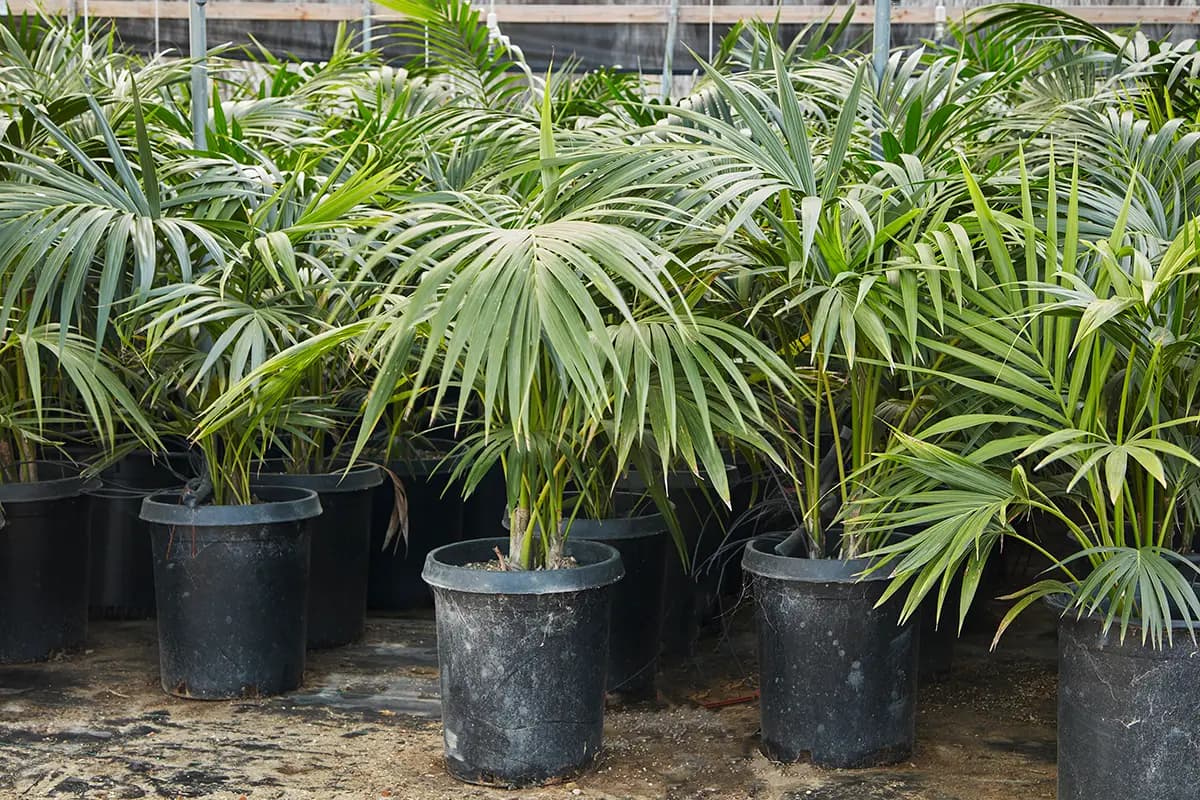
Howea forsteriana (kentia palm) crop in production at our wholesale nursery Grubb & Nadler in Fallbrook, CA
CHOICE PALMS FOR THE COOLER COAST
Parajubaea torallyi var. torallyi (Pasopaya palm)
A fast-growing, very rare, majestic tree from high in the Bolivian Andes. Looks like a husky coconut palm. Give it full sun, good drainage, ample water, and stand back and watch it develop into a graceful and substantial palm tree with a hefty, fiber-clad trunk and finely divided feather leaves that sway in the breeze. Once established, it will tolerate drought. Can reach 20 feet tall in 15 years. Produces edible miniature coconuts. Enjoys the California’s cool and warm microclimates and will tolerate moderate frosts. Plant as young as possible and with no root disturbance. Modest seashore tolerance, but otherwise adaptable from the foggy Northern California coast to the Inland Empire (Sunset zones 9, 14–24).
Max height: 80 feet in 100 years
Max crown breadth: 25 feet
Rare, Majestic, Fast growth, Hardy
Parajubaea sunkha (Zunca palm)
A fast-growing, very rare tree from the Bolivian Andes. Looks like a silvery coconut palm. Give it full sun, good drainage, ample water, regular fertilizer, and watch it develop gradually into a graceful and substantial palm with a moderate, fiber-clad trunk and finely divided feather leaves. Once established, it will tolerate drought. Can reach 15 feet tall in 15 years. Produces edible miniature coconuts. Enjoys California’s cool and warm microclimates and will tolerate moderate frosts. Plant as young as possible and with no root disturbance. Modest seashore tolerance, but otherwise adaptable from the foggy NorCal coast to the Inland Empire (Sunset zones 9, 14–24).
Max height: 40 feet in 100 years
Max crown breadth: 20 feet
Rare, Graceful, Moderate growth, Hardy
Read more: Rare and Elegant Parajubaea Palms
Hedyscepe canterburyana (umbrella palm / big mountain palm)
One of the most colorful, clean-looking and graceful palms we can grow in California, this native of Australia’s tiny Lord Howe Island in the South Pacific develops a powdery blue-green trunk and crownshaft, apple-green foliage, and lipstick-red fruits the size of robin’s eggs. It prefers a bright, semi-shaded position in well-drained soil, and regular water and fertilizer. Its slow growth and modest proportions make it perfect for small gardens, reaching 10 or 15 feet in 30 years, with a crown spanning five to ten feet. It tolerates light frosts but should be planted only in the mildest coastal and foothill communities where the marine layer is a regular occurrence and frost is quite rare. Minimize root disturbance upon planting. Thrives in the foggiest seaside neighborhoods, but not especially tolerant of direct coastal exposure.
Max height: 30 feet in 75 years
Max spread: 3-5 feet
Exceptionally beautiful, Rare
Ceroxylon quindiuense (Andean wax palm)
One of the endangered wax palms of the Andes and the tallest palm (and monocot) in the world, this very tall Colombian cloud-forest tree will function as a luxuriant foliage element for decades before developing its wax-smooth, white, ringed trunk and becoming a spectacular skyline feature. Plant in shade or part sun (where foggy) in rich, well-drained soil (even clay if sloped), water regularly, and it will steadily produce long, dark-green, glossy, silver-satin-backed leaves. Tolerant of light frosts, it is best in foggy, cool coastal climates (Sunset zones 16-17, 22–24, and mild, woodsy parts of 15). It’s not tolerant of direct coastal exposure, and at its best in areas of year-round cool nights.
Max height: 100 feet in 70 years
Max spread: 20 feet
Rare, Exceptionally beautiful, Well-adapted to the coolest, foggiest parts of coastal California
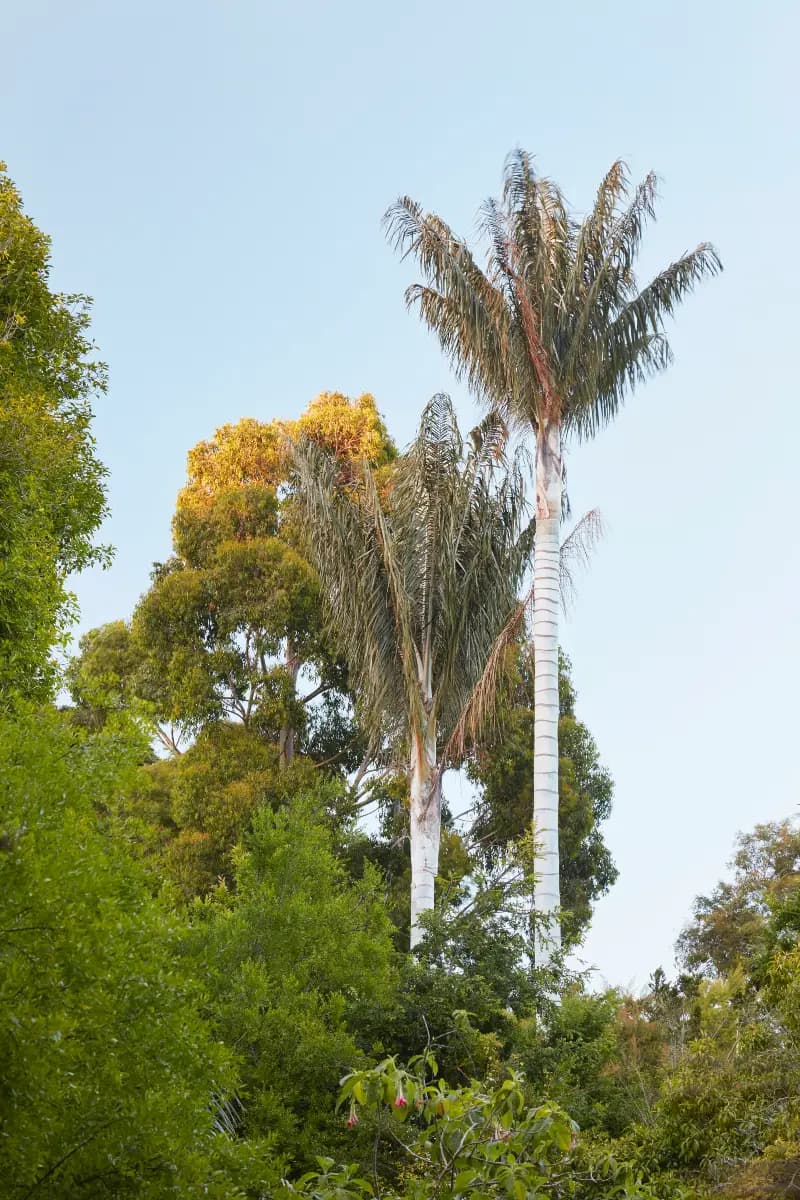
The rare and beautiful Ceroxylon quindiuense growing happily in the San Francisco Botanical Garden
MORE RARE PALMS WE GROW
Beccariophoenix alfredii (high plateau coconut palm)
This native of Madagascar’s high plateau is the closest thing to a coconut palm we can grow in coastal California. For many years it’s a swaying foliage feature, and then an upright trunk develops. It tolerates cold, drought, heat, and wind, and handles part shade to full sun. Water it regularly while it gets established. If you plant a 15-gallon or larger at a lean, it will grow the classic coconut-palm arch. Hardy to 25F.
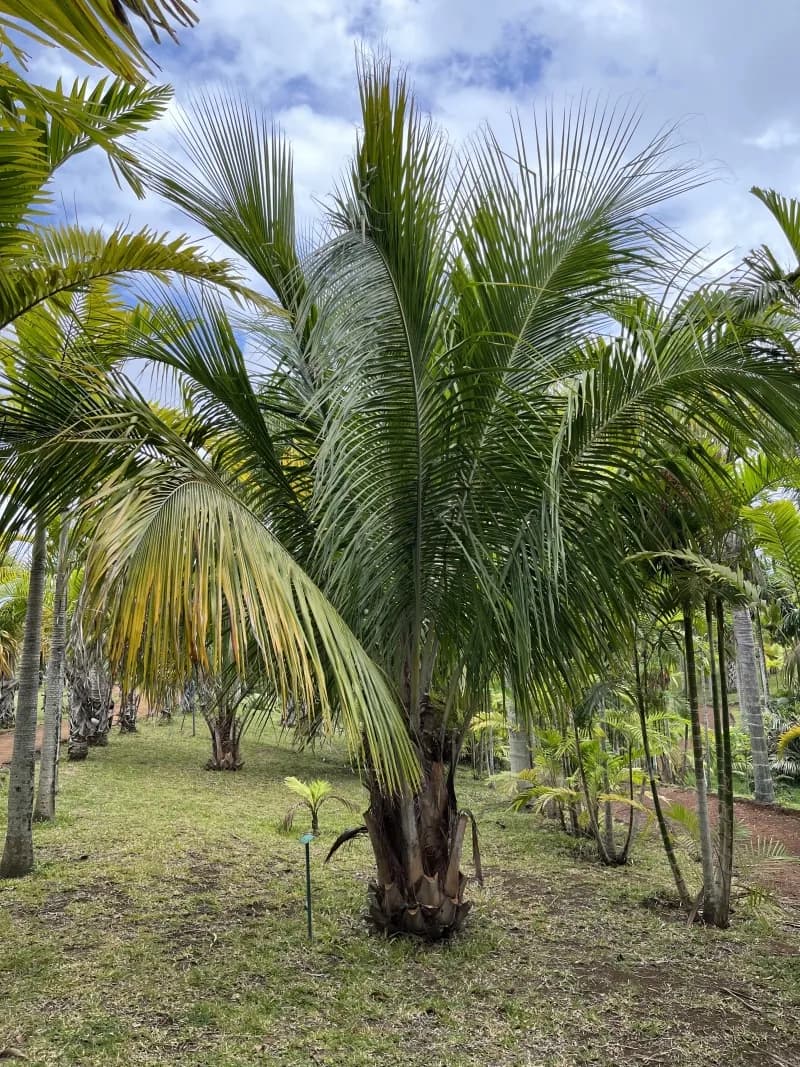
Brahea ‘Super Silver’ (silver rock palm)
New to cultivation, this unarmed, modest-size fan palm from central Mexico starts out green and turns more silver every year. It tolerates low water, heat, wind, pots, and even rooftops. Plant it in well-drained soil or a pot. Hardy to 22F.

Butia x Syagrus (mule palm)
A cross of the pindo palm and the queen palm, the mule palm shows real hybrid vigor: it grows faster than either parent. Its long, bouncy leaves have recurved tips. It tolerates drought, salt, and wind, and handles a wide range of climates. Hardy to 18F.
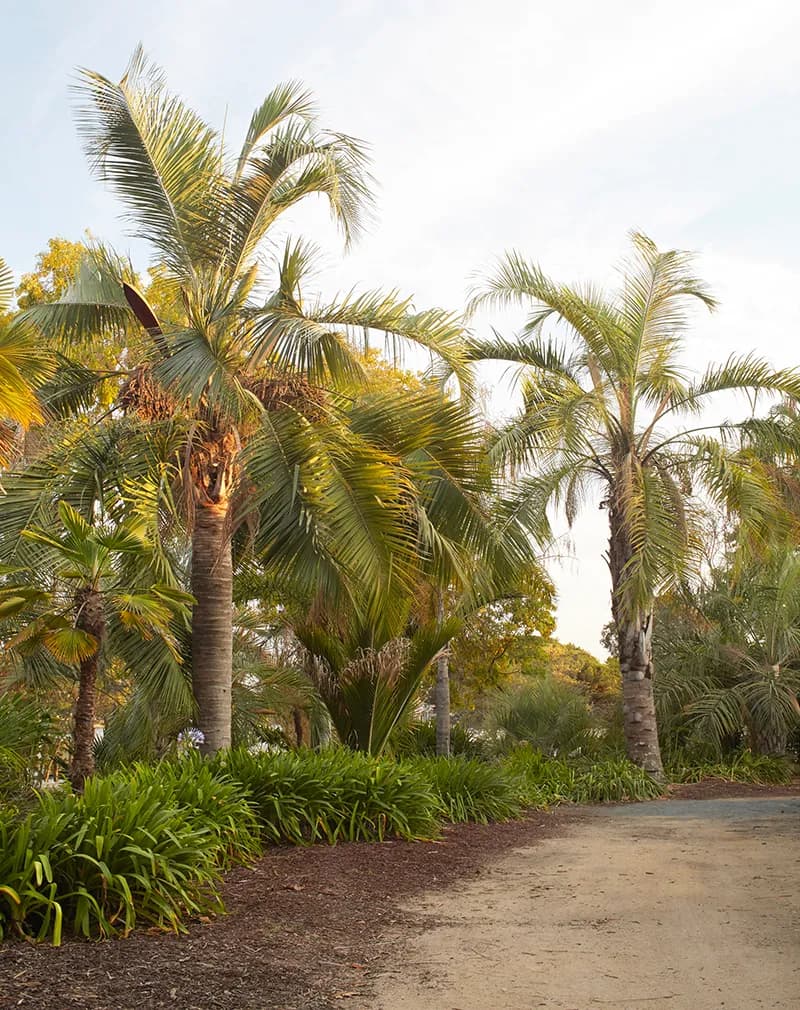
Caryota maxima ‘Himalayan’ (Himalayan fishtail palm)
A fast-growing, tropical-looking palm that becomes a pagoda-shaped tree. It’s narrow and upright, so it’s useful for fitting lush greenery and privacy into tight spaces. It tolerates cool summers and wants ample water. Like all fishtail palms, it lives about 30 years, flowers, and then dies. Hardy to 26F.
Chamaedorea costaricana (bamboo palm)
A fast, upright clumping bamboo palm that’s excellent for the fog belt. Shade suits it best, but mature plants take some morning or late-afternoon sun. Fragrant flowers are followed by showy black fruit on orange stalks. Nice in a pot. Hardy to 28F.
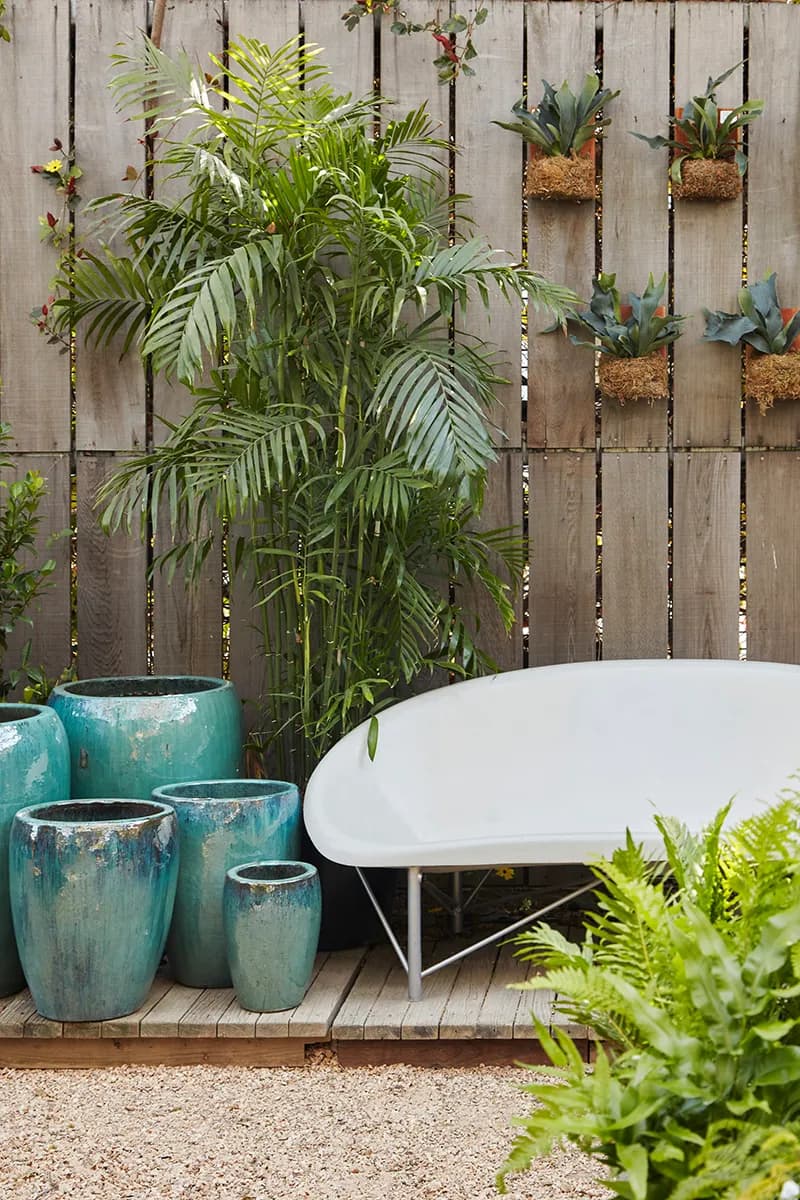
An exquisite, slow-growing foliage palm for shady understory planting and containers, with picturesque fishtail leaves on a thin trunk. It stays small (2–5 feet) and is happy with cool summers and fog. Hardy to 30F.
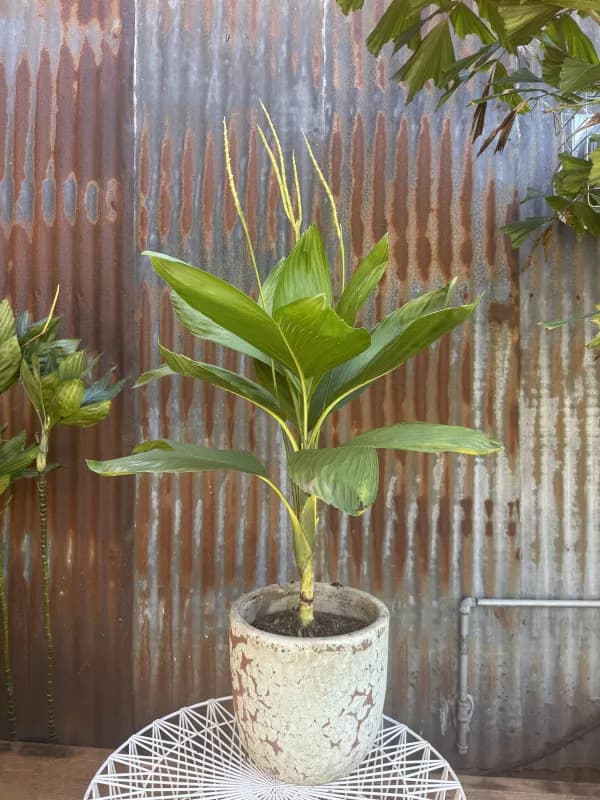
Chamaedorea radicalis ‘Tree Form’ (hardy parlor palm)
The hardiest species in the genus: a dainty single-stem palm tree that looks best planted in groves, and female plants bear showy orange fruit. Give it shade to part sun. It does well wherever summer days reach the upper 60s, which is nearly everywhere except the immediate coast. Nice in containers. Hardy to 18F.
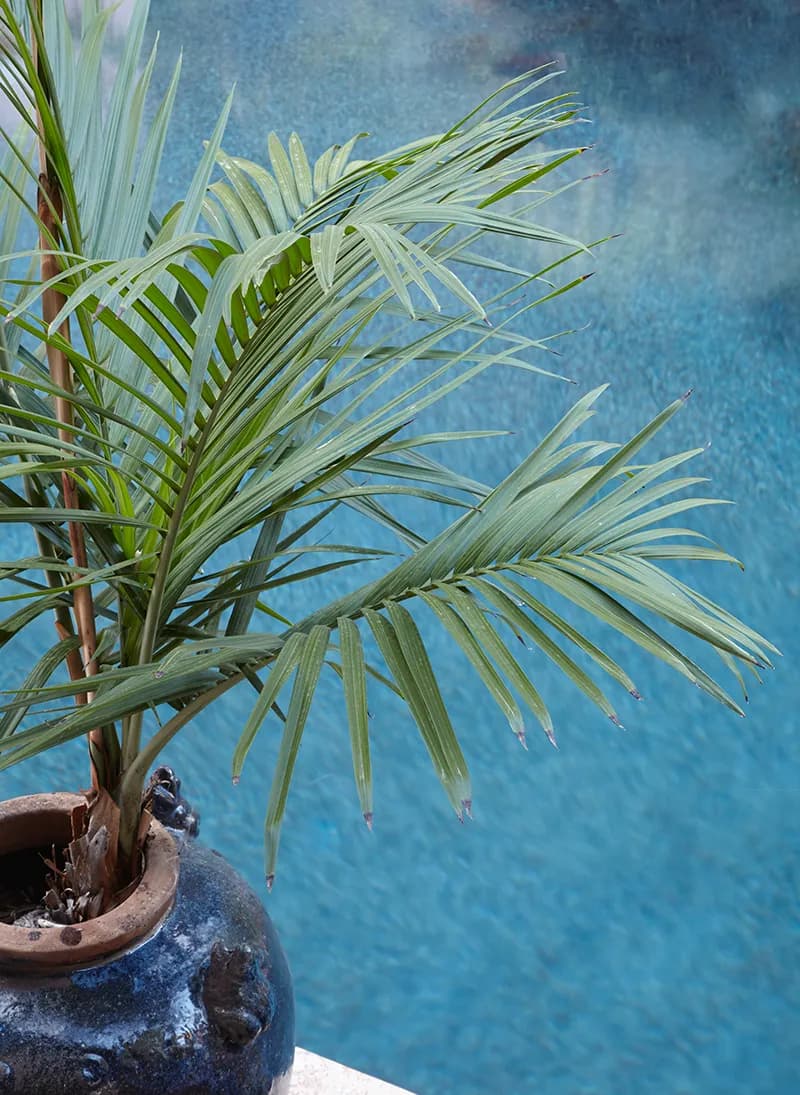
Pritchardia hillebrandii (huelo loulu palm)
A charismatic, modest-size fan palm from coastal Molokai, and the most widely grown Hawaiian palm in California. Its pleated leaves have stems dusted with a creamy fuzz. It handles coastal wind better than other pritchardias but suffers in hot, dry offshore winds. Protect it from frost. Good in pots, especially where winters are longer and wetter. Hardy to 32F.
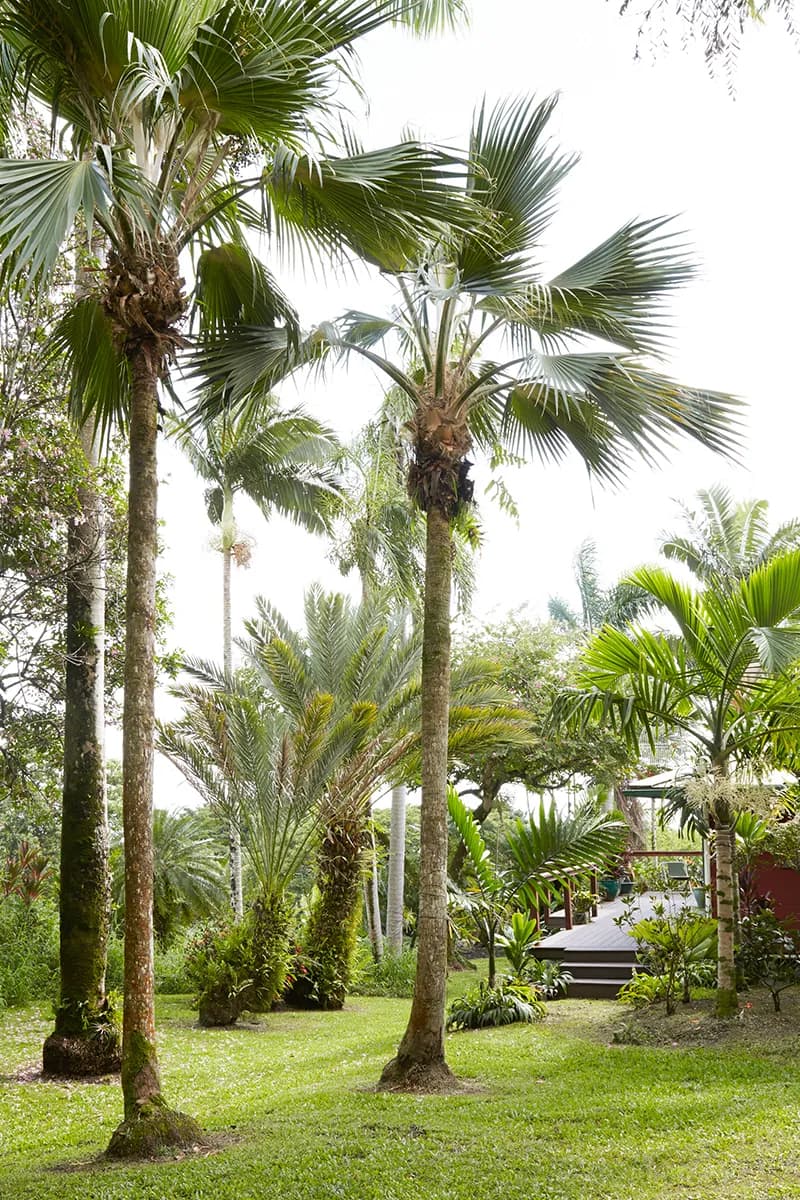
Pritchardia minor (Kokee loulu palm)
A charismatic fan palm from Kauai and our best pritchardia for the fog belt. Its leaves have satiny undersides, and its flower stalks have golden fuzz. It grows slowly, which makes it the right size for small gardens. Keep it away from hot, dry wind. Traditional Hawaiians peeled and ate its young fruits (hāwane). Hardy to 30F.
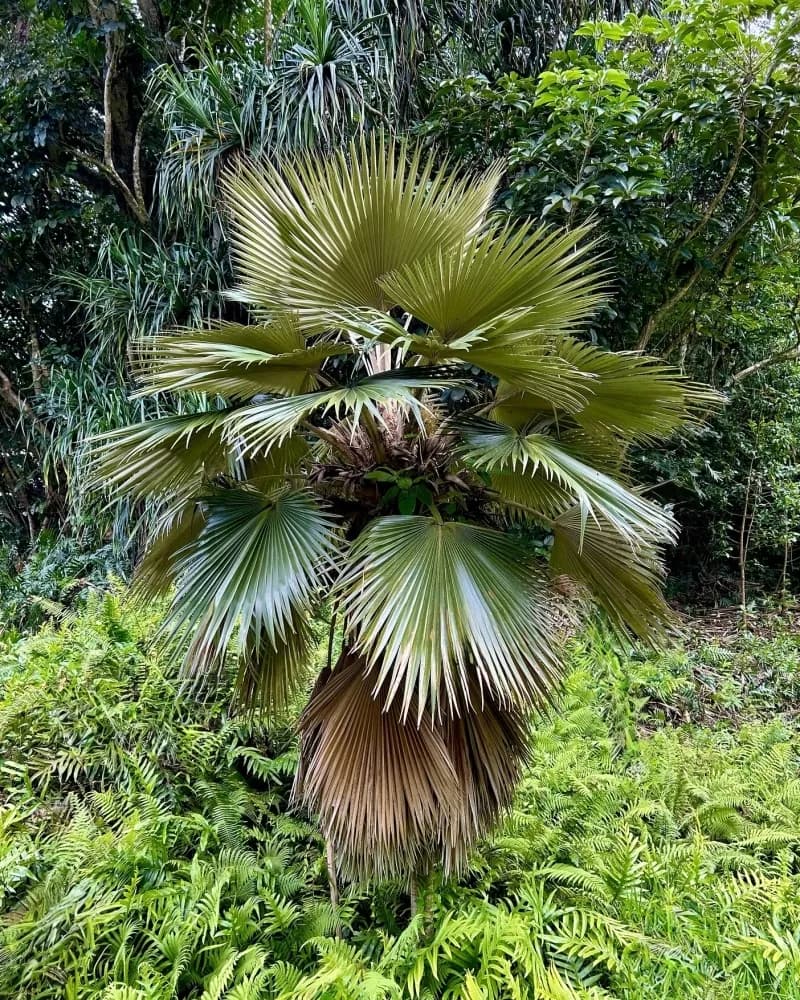
Syagrus weddelliana (wedding palm)
An exquisite miniature feather palm from Brazil’s Atlantic forest. It’s lovely in shady understory plantings and in pots. It’s best in warm-summer areas with good drainage, where mature plants can produce marble-size coconuts. Hardy to 25F.
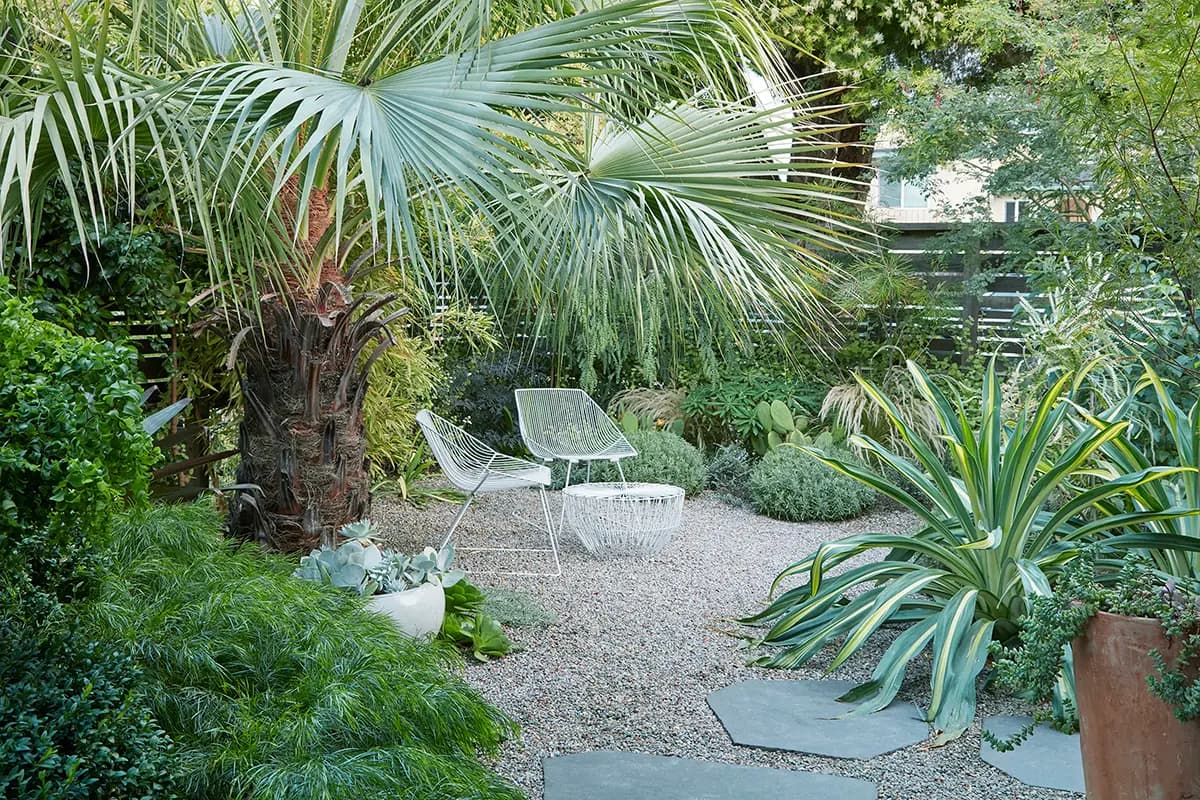
Brahea clara in Flora Grubb’s own Berkeley garden
Read more: The Rare and Lovely Brahea clara Palm
SELECTING PALM SPECIES
SCREEN BY THESE CRITERIA when selecting palm species for your garden: aesthetic appeal, design function, frost-tolerance, heat requirements, wind tolerance, sun tolerance, and water needs. Most soils can be amended.
EXCELLENT CHOICES FOR THE COOL-SUMMER COAST:
Rhopalostylis spp. (nikau & Norfolk palms): Rhopalostylis sapida and Rhopalostylis baueri
Parajubaea spp. (Andean “coconut”/”coquito” palms): Parajubaea torallyi and Parajubaea sunkha
Trachycarpus spp. (windmill palms): Trachycarpus fortunei, Trachycarpus latisectus, and Trachycarpus martianus
Brahea armata var. clara (Sonoran blue palm)
Brahea edulis (Guadalupe palm)
Butia odorata (pindo palm)
Chamaedorea spp. (bamboo palms): Chamaedorea plumosa, Chamaedorea hooperiana, Chamaedorea microspadix, Chamaedorea costaricana, Chamaedorea ernesti-augusti, and Chamaedorea radicalis ‘Tree Form’
Livistona spp. (Australian fan palms): Livistona decora, Livistona chinensis, and Livistona australis
Jubaea chilensis (Chilean wine palm)
Jubaea x Butia hybrid
Howea forsteriana (kentia or paradise palm)
Hedyscepe canterburyana (umbrella palm)
Ceroxylon quindiuense (wax palms)
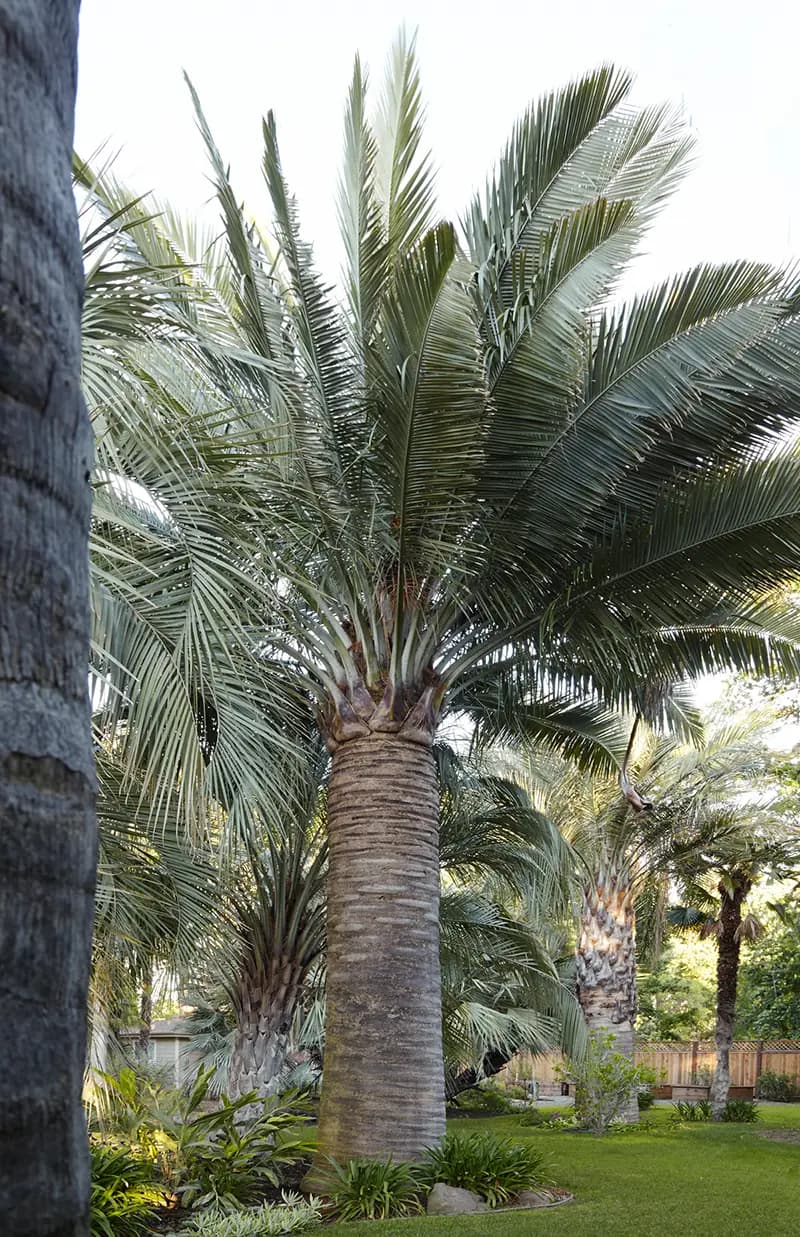
The rare and beautiful Chilean wine palm (Jubaea chilensis) grows happily in coastal fog or inland heat.
EXCELLENT CHOICES FOR INLAND AREAS WITH MORE EXTREME TEMPERATURES:
Butia odorata (pindo palm)
Brahea spp. (Mexican blue palm and many others): Brahea edulis, Brahea clara, and Brahea ‘Super Silver’
Jubaea chilensis (Chilean wine palm)
Chamaerops humilis (Mediterranean fan palm)
Chamaerops humilis ‘Cerifera’ (silver Mediterranean fan palm / blue Atlas fan palm)
Livistona decora (ribbon palm)
Livistona australis (Australian fan palm)
Trithrinax spp. (Argentine fan palm): Trithrinax acanthocoma
Sabal spp. (palmettos): Sabal causiarum and Sabal uresana
Trachycarpus spp. (windmill palms): Trachycarpus fortunei, Trachycarpus latisectus, and Trachycarpus martianus
Phoenix dactylifera (true date palms)
EXCELLENT CHOICES FOR WINDY SHORELINE LOCATIONS:
*Worth a try: Parajubaea, Howea, Rhopalostylis, P. dactylifera ‘Zahidi’ & ‘Medjool’, Sabal, Trithrinax
BANANA BELT TREATS FOR COMMUNITIES IN MILDER CLIMATES:
Pritchardia spp. (Hawaiian fan palm): Pritchardia hillebrandii and Pritchardia minor
Archontophoenix cunninghamiana (king palm)
Dypsis baronii (hardy areca palm)
Caryota maxima and Caryota obtusa/gigas (fishtail palms)
Chamaedorea tepejilote (pacaya palm)
Howea forsteriana (kentia palm) and Howea belmoreana (curly palm)
Ravenea glauca (mini-majesty palm)
Rhapis spp. (lady palms): Rhapis excelsa
GROWING PALMS: TIPS AND TRICKS
- Good drainage & consistent water: few palms tolerate drying out, and few tolerate cold, wet roots.
- Fertilizer: Apply NPK 3-1-3 + 1 magnesium in March, June & September.
- Palms start growing slowly and accelerate.
- Good to plant slow-growing species large.
- Palms are slow to adapt to increased light levels.
PLANTING AND TRANSPLANTING
- Spring-summer is the best season for planting.
- Never manipulate rootballs—leave intact.
- Tight fit with foundations & walls works fine.
- Keep original rootball moist and irrigate surrounding soil to encourage establishment.
MORE ABOUT PALMS